Employee monitoring for law firms| EmpTrakr
Employee monitoring for law firms needs a clear purpose, limited collection, transparent policies, and practical review steps for remote and hybrid teams.
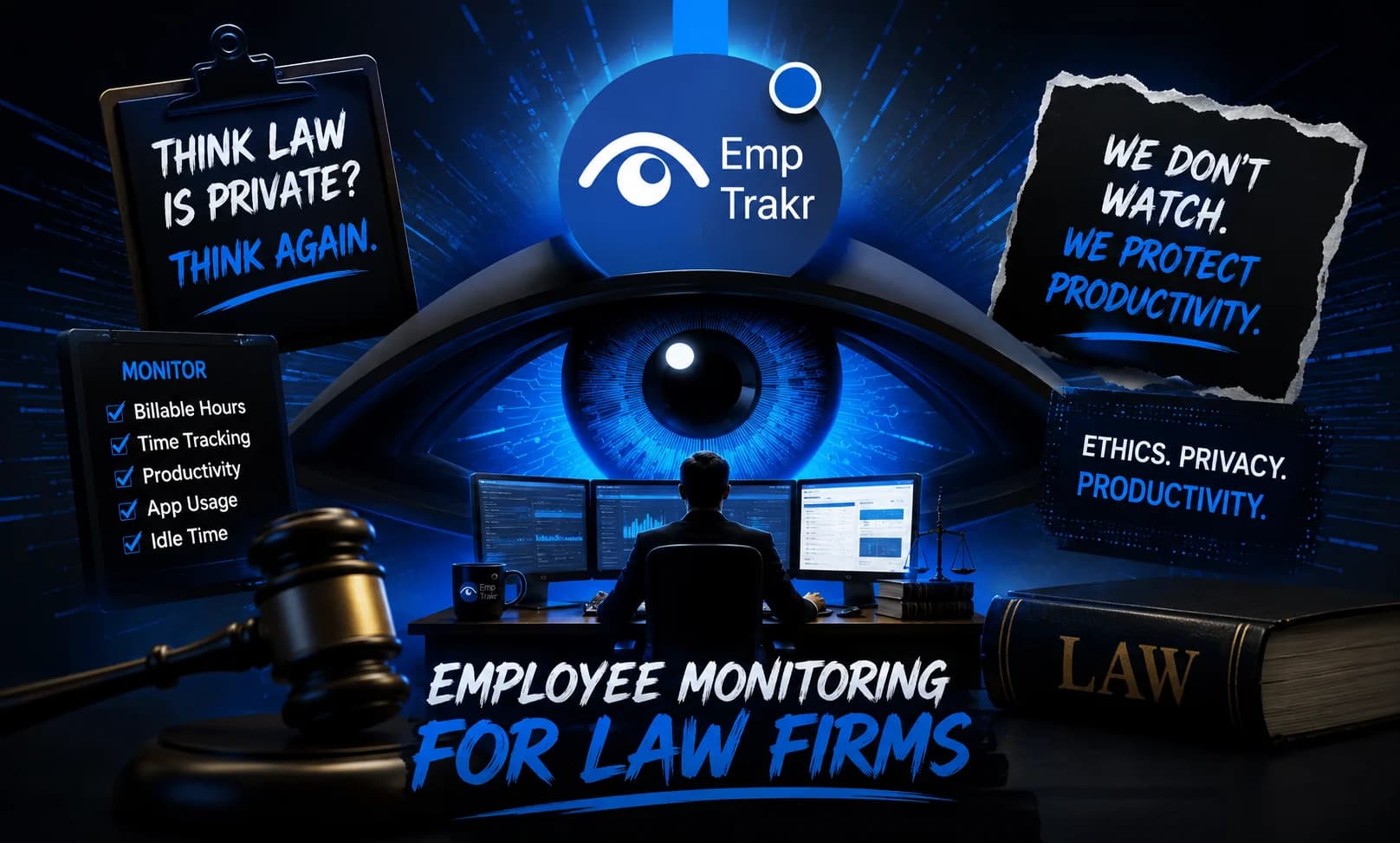
Employee monitoring for law firms should support a defined work process, not broad surveillance. The right approach starts with purpose, transparency, limited data collection, and a review path for concerns. Choose tools around time tracking, attendance, or workflow visibility only when they fit the firm’s policy and working practices.
Employee monitoring for law firms: definition and decision context?
Employee monitoring for law firms is the use of software or workplace processes to understand work activity, time, attendance, or workflow progress. The useful question is not whether a firm can collect information, but whether a particular form of visibility serves a clear operational purpose.
A firm might be trying to understand time spent on client work, coordinate a remote schedule, support payroll timesheets, or identify a process that creates avoidable delays. Those are different needs and should not automatically lead to the same monitoring configuration. A time-tracking workflow may be enough for one team, while another may need attendance records or project-level activity summaries.
Begin by writing the decision the data is meant to support. Then define the smallest set of information needed for that decision. This keeps the discussion practical and gives managers, HR administrators, and employees a shared point of reference. The firm can also explain what the tool cannot establish, so a report is not treated as a complete account of someone’s work.
For a broader overview of the category, see Employee monitoring software Before comparing individual workflows.
Who should consider employee monitoring for law firms?
Law firms should consider workplace monitoring only when a defined operational problem is difficult to understand through ordinary management practices. The strongest starting point is a narrow use case, such as recording billable time, organizing attendance, or giving remote teams a consistent way to report work.
Managers may find structured records useful when work is distributed across locations or when several people contribute to the same matter. HR administrators may focus on consistent attendance or timesheet handling. Founders and practice leaders may want a clearer view of workflows that depend on handoffs. Each audience should receive only the access and detail needed for its role.
Monitoring is less suitable when the underlying goal is simply to watch people more closely. That objective is difficult to translate into a fair policy and can encourage over-collection. Before selecting a tool, ask whether a meeting, project checklist, supervisor review, or clearer workload process would answer the question with less intrusion.
If the need is primarily hours and schedules, compare it with a focused Time tracking software Workflow rather than beginning with the most expansive feature set.
Benefits and practical limitations
Structured monitoring can make routine work records easier to organize, but it does not remove the need for judgment. A carefully designed system may reduce manual timesheet work, create a common record for discussions, or help a remote team see where a process needs attention.
Potential benefits
- Creates a consistent way to record selected work activity.
- Can support conversations about workload, schedules, and handoffs.
- May reduce ambiguity when teams use different working locations.
- Can connect an operational record with a defined internal process.
Practical limitations
- A report may show activity without explaining its purpose or quality.
- Detailed collection can capture information unrelated to the stated need.
- Managers may over-read signals when policy and context are unclear.
- Employees may lose trust if access, retention, or review rules are vague.
The safeguards should be designed alongside the workflow. Separate administrative records from performance judgments where possible, limit access by role, and provide a way to correct an inaccurate record. A policy should also explain how managers handle unusual situations, including client calls, research, reading, training, and work away from a keyboard.
For teams considering activity visibility, the guide to Productivity tracking Can help distinguish operational signals from conclusions about individual performance.
Suitable employee monitoring software for smbs 2026 and the reader decision
For a small or growing firm, suitable software is the option that matches the stated workflow without adding unnecessary collection or administrative complexity. A decision should begin with the record the firm actually needs: hours, attendance, project progress, or a limited activity signal.
Use a short requirements list before reviewing products. Identify the users, the workspaces or matters involved, the managers who need access, the reports required, and the retention approach. Then separate essential functions from optional features. This prevents a broad product description from becoming an accidental monitoring policy.
A fair comparison should also examine the employee experience. Ask how the firm explains the tool, how people can check their records, how corrections are handled, and how managers are expected to interpret results. A technically capable system may still be a poor fit if the surrounding process is unclear.
For a direct comparison of collection choices, review Screenshot monitoring As a distinct workflow rather than treating screenshots as a default requirement. The choice should follow the purpose, not the other way around.
Free employee monitoring software and the reader decision
Free software can be a useful way to test whether a defined workflow is worth formalizing, but a free label does not answer the policy questions. The firm still needs to decide what information is collected, who sees it, how long it is kept, and how employees are informed.
Start with a limited pilot process that uses the least sensitive record capable of answering the operational question. Document the workflow before enabling it, invite questions, and review whether the reports are understandable. If the system produces more information than the team can interpret responsibly, adding more monitoring is unlikely to solve the problem.
Cost is only one part of suitability. Consider the time required to administer the system, train managers, explain the policy, respond to corrections, and keep access appropriate. A simple timesheet process may be more useful than a feature-heavy setup when the firm’s need is limited to hours or project allocation.
Attendance-focused teams can also compare a dedicated Attendance tracking Workflow with broader activity collection. Keeping these options separate makes it easier to explain the purpose and limits of the chosen process.
Conclusion
Employee monitoring for law firms is most defensible as a focused operational practice, not a general invitation to observe every action. Start with a written purpose, select the narrowest useful workflow, and make the policy understandable to the people affected by it.
Before implementation, decide how access, corrections, retention, and manager review will work. Consider the employee experience as part of the system rather than an afterthought. A clear process can support time, attendance, and remote-work coordination without turning every report into a judgment about performance.
Finally, use the firm’s own needs to guide the next step. Review the Security & privacy Information, compare the proposed workflow with the firm’s existing policies, and seek appropriate professional advice when the intended use raises questions about privacy, employment practice, or client confidentiality.
Frequently Asked Questions
What is employee monitoring for law firms?
Is employee monitoring for law firms suitable for the target audience?
How should readers evaluate employee monitoring for law firms safely?
Related EmpTrakr resources
Continue with product pages that match this topic — and explore more guides on the blog.
Supercharge your workforce today.
Join leading companies using EmpTrakr to boost productivity, streamline tracking, and optimize remote teams.