Automatic Time Tracking Software: Smarter Work Tracking| EmpTrakr
Discover how automatic time tracking software simplifies work-hour tracking, improves productivity, and creates clearer employee work records.
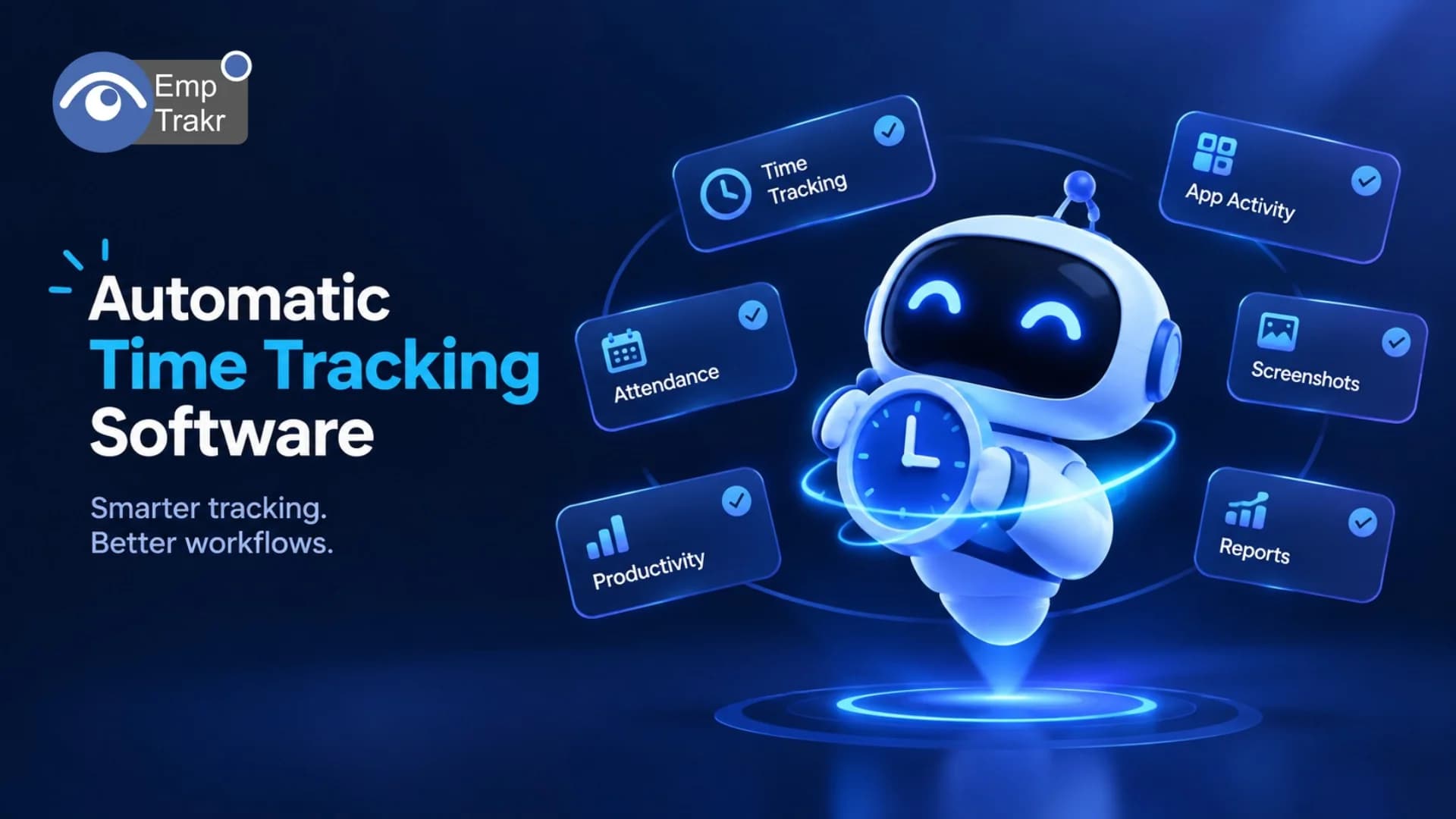
Automatic time tracking software can reduce manual timesheet work by helping people recover work activity and review records before submission. It should support clear reporting without turning every digital action into a judgment about performance. The right choice depends on workflow, transparency, privacy expectations, and the level of human review your team needs.
Automatic time tracking software: definition and decision context?
Automatic time tracking software helps create work records with less manual starting and stopping. In practice, the useful question is not whether a system can collect activity, but whether the resulting record is understandable, reviewable, and suitable for the team’s workflow.
A 2026 comparison describes a human-reviewed approach built around recovering forgotten work, turning it into records for billing or reporting, and allowing a person to decide what reaches the timesheet.The human-reviewed approach That description is a useful decision context, but it is not proof that every tool works in the same way. The source discusses particular products and audiences, so readers should not generalize its conclusion to every employer, role, or remote-work arrangement.
For managers, the distinction matters. A time record can support project administration, client reporting, payroll preparation, or internal planning. It should not automatically become a proxy for effort, attention, or value. Before reviewing products, write down the operational result you need: a timesheet, a project record, an attendance record, or a prompt to complete missing entries.
That starting point also helps separate Employee monitoring software From a narrower time-recording workflow. The two categories may overlap, but they do not have to be treated as interchangeable. A team that needs timesheets may not need screenshots, application-level observations, or continuous activity review.
Who should consider automatic time tracking software?
Teams should consider an automatic time-recording workflow when manual logs are frequently incomplete, difficult to reconcile, or disconnected from the way work is actually organized. It is less suitable when the proposed system cannot explain what is collected, who can see it, or how a worker can correct a record.
The 2026 comparison makes a clear editorial point: the useful tracker is not necessarily the one that records the most data.The data-minimization point For a remote or hybrid team, that suggests evaluating the quality of the final record rather than treating a larger monitoring footprint as automatically more accurate.
Software teams, agencies, and consultants may have different reasons to reconstruct work time. One cited comparison specifically discusses human-reviewed AI time tracking for those groups, alongside complete timesheets and an approach that avoids employee surveillance.The cited audience and workflow That is evidence about the source’s described use case, not a universal suitability statement.
A practical screening conversation can stay simple. Ask whether the team needs project allocation, client billing support, attendance context, or only a reminder to complete a timesheet. Then ask whether employees can inspect and amend entries. If the answer to either question is unclear, pause the evaluation rather than adding more data collection.
For broader comparisons, start with Time tracking software And keep the search focused on the workflow. A product that sounds technically sophisticated may still be a poor fit if its records require extensive cleanup or create confusion about what managers are entitled to infer.
Benefits and practical limitations
Automatic collection can make time records easier to assemble, but convenience does not remove the need for review. The main benefit is a simpler path from work activity to a usable record. The main limitation is that activity signals may need interpretation, correction, or exclusion before anyone uses them for reporting.
One published guide states that it checked features and public prices against official vendor pages on September 11, 2026.The stated vendor-page check That date is useful context for the guide, but it is not a promise that features or prices remain unchanged. A buyer should confirm current details directly before making a decision.
Potential advantages
- Less reliance on memory when preparing a timesheet.
- A clearer starting point for reviewing project or client records.
- A workflow that can keep a person involved before an entry is finalized.
- More consistent prompts for teams that struggle with manual recording.
Practical limitations
- Collected activity may not explain the purpose or quality of the work.
- Records can be incomplete when work happens outside tracked environments.
- Employees may distrust a system that is introduced without a clear policy.
- Managers can overinterpret activity unless the review standard is defined in advance.
The safest comparison process therefore looks beyond feature lists. Check what the system records, what it leaves out, how edits are handled, and which reports are visible to managers. Also decide whether the tool will be used for administration or for individual evaluation. Those are different responsibilities and should not be blended casually.
If the operational goal is broader than time records, review Productivity tracking Separately. If the goal is visual evidence of work context, read about Screenshot monitoring As a distinct policy decision rather than assuming it belongs in every time-tracking setup.
Absence tracking software and the reader decision
Absence tracking software should be assessed as a scheduling and record-keeping need, not automatically as an extension of employee surveillance. The decision becomes clearer when a team defines which absence information is necessary, who needs access, and how corrections will be handled.
Keep this workflow separate from automatic time capture where possible. A record of time spent on work and a record of unavailable time answer different operational questions. Combining them may be appropriate for a particular process, but it can also make a simple absence request harder to understand.
For a small or distributed team, write the policy before choosing the interface. State what employees are expected to submit, what managers may review, and what happens when a record is incomplete. Use plain language. Avoid implying that a system can determine intent, effort, or the reason behind an absence.
The same discipline helps when considering attendance tracking software free or paid. Begin with the minimum record needed for the stated workflow, then test whether the product makes that record easy to review. A lower-cost option is not automatically a better fit, and a more expansive option is not automatically more appropriate.
Teams that need a dedicated attendance workflow can compare Attendance tracking With time recording rather than treating the labels as synonyms. This keeps the evaluation tied to a real administrative task and gives employees a clearer explanation of why information is collected.
App tracking software and the reader decision
App tracking software should be considered only when application context is necessary for a defined operational purpose. It should not be selected simply because it produces more detailed activity information. The decision should account for transparency, access, retention, and how the resulting information will be interpreted.
Application usage can be a sensitive part of a workplace policy because the same activity may have several explanations. A tool can show that an application was open, but that does not by itself explain the quality, urgency, or outcome of the work. Managers should avoid turning an application signal into a standalone performance conclusion.
A useful evaluation asks four questions. Is the information necessary for the workflow? Can employees understand what is collected? Can records be corrected or challenged? Can managers use the information without expanding its purpose later? If the answer is uncertain, narrow the proposed collection before testing software.
For remote teams, communication may matter as much as configuration. Explain the purpose before deployment, document the review process, and give workers a route for raising questions. This is practical governance rather than a software feature, but it determines whether the tool supports a workable relationship with the team.
Where app context is not necessary, a simpler automatic time tracking app may be easier to explain and maintain. Where it is necessary, connect it to a written policy and a limited reporting need. The aim is a useful work record, not an exhaustive digital portrait.
Conclusion
Automatic time tracking software is worth evaluating when it reduces manual record keeping without making broad judgments from narrow activity signals. Start with the record your team needs, define who reviews it, and decide what employees can correct before comparing features.
The available research supports a cautious principle: more captured data is not automatically a better time record.The comparison’s central principle A separate review also frames selection around the features a business should look for in a time-tracking system.The feature-selection question Neither source supplies a universal policy for every workplace, so local rules, workforce expectations, and the intended use should remain part of the review.
Use Installation guidance Only after the policy and workflow are clear. Then confirm current product details through Security & privacy Information and the provider’s current documentation. A measured rollout, clear explanation, and human review are more useful safeguards than simply enabling every available tracking option.
Sources
Frequently Asked Questions
What is automatic time tracking software?
Is automatic time tracking software suitable for the target audience?
How should readers evaluate automatic time tracking software safely?
Related EmpTrakr resources
Continue with product pages that match this topic — and explore more guides on the blog.
Supercharge your workforce today.
Join leading companies using EmpTrakr to boost productivity, streamline tracking, and optimize remote teams.