Free Time Tracking Software for Employees:The Real Shortlist| EmpTrakr
Compare free time tracking software for employees, including time tracking, attendance, reports, user limits, and features worth checking.
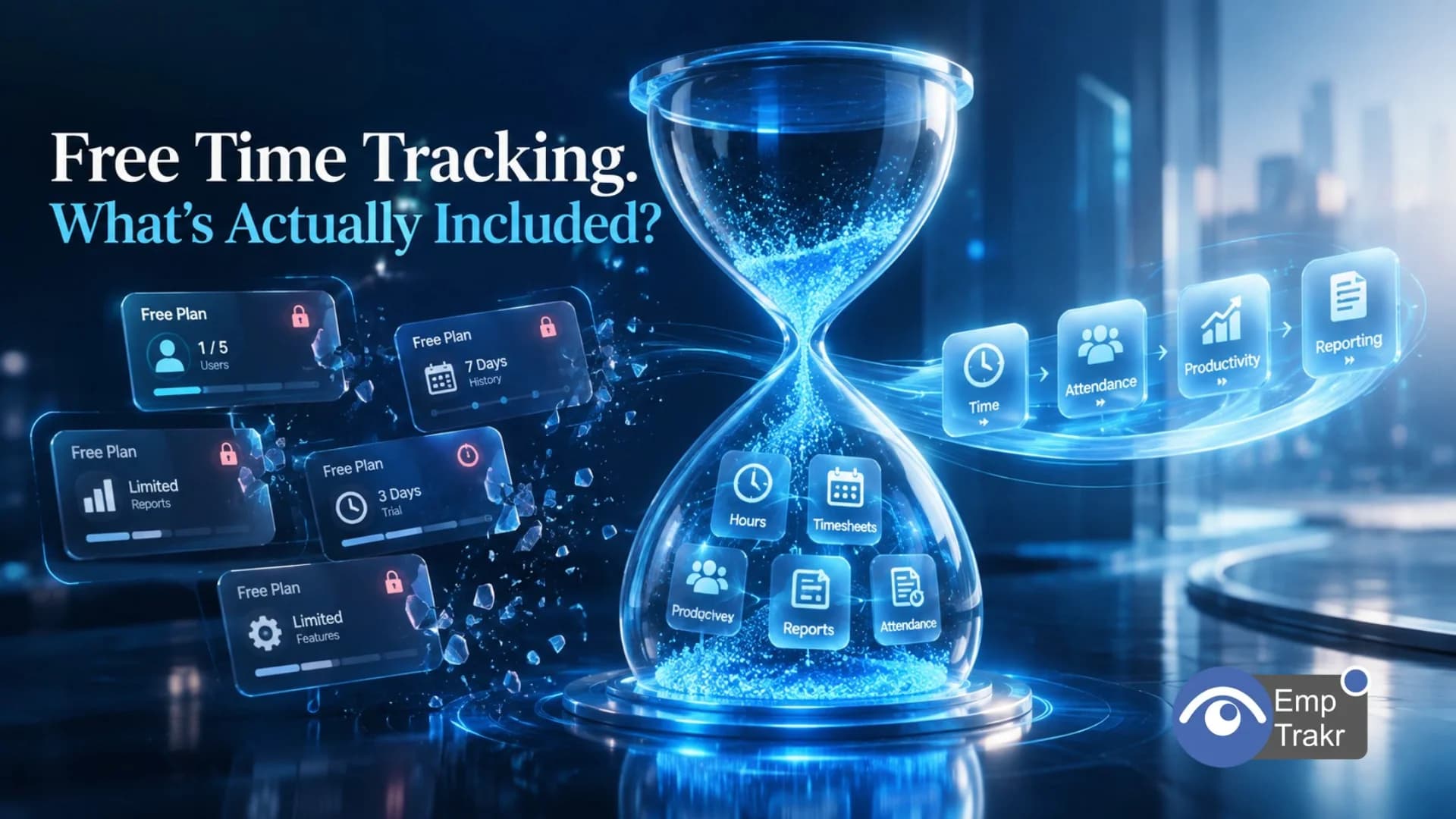
Finding Free time tracking software for employees Sounds easy until you start comparing what “free” actually includes.
Some tools offer a permanent free plan. Others provide only a limited trial. Some restrict the number of employees, while others limit reports, time history, integrations, or advanced workforce features.
For small businesses and remote teams, the real question isn't simply whether a time tracker costs $0.
It's:
Can your team actually use it without hitting a limitation immediately?
This guide looks at what to check in free employee time tracking software and how to choose an option that remains useful as your team grows.
Quick Answer: What Should a Free Time Tracker Include?
A useful free employee time tracker should ideally cover the basics:
Employee working hours
Start and stop time
Breaks and idle time
Timesheets
Attendance
Productivity visibility
Basic reporting
Employee/user management
Some platforms also combine time tracking with application activity, productivity monitoring and screenshots.
The exact features and limits vary between providers, so always check the current free-plan terms before signing up.
What Is Free Time Tracking Software for Employees?
Employee time tracking software records working time digitally instead of relying on manual timesheets.
Depending on the platform, employees may be able to track when they start and finish work, while managers can review working hours and related reports.
For remote and hybrid teams, this can simplify a process that otherwise depends heavily on spreadsheets and manual updates.
A dedicated Time tracking software Platform can help centralize working-hour information and make it easier to review time records.
However, time tracking is only one part of workforce management.
A business may also need attendance, productivity and activity information.
What Makes a Free Time Tracker Worth Using?
Not every free time tracker provides the same value.
Before choosing one, look at these five areas.
1. Number of Employees
The first question is simple:
How many employees can use the free plan?
A free plan for one or three users may be fine for a freelancer or tiny team.
But if you have 15 employees, the plan isn't particularly useful if it requires an upgrade after the third user.
For growing teams, check whether the provider offers unlimited users or charges per employee.
2. Time Tracking Features
Basic time tracking should make recording working hours simple.
Look for features such as:
Start/stop tracking
Working-hour records
Break tracking
Idle-time information
Timesheets
Daily and weekly summaries
The interface should make it easy for employees to record time without adding unnecessary administrative work.
3. Attendance
Time tracking and attendance are related but different.
Time tracking answers:
“How much time was recorded?”
Attendance answers:
“Was the employee present according to the expected schedule?”
For teams that need both, Attendance tracking Can complement time tracking by providing check-in, check-out and schedule information.
This is particularly useful for remote and hybrid teams.
4. Reporting
A time tracker becomes much more useful when you can turn recorded hours into understandable reports.
Look for:
Daily reports
Weekly reports
Employee timesheets
Team summaries
Attendance reports
Export options
However, reporting is one area where free plans often become limited.
A provider may allow time tracking for free but reserve advanced reports or exports for paid customers.
5. Scalability
A free tool may work perfectly when you have five employees.
But what happens when you have 25?
Or 50?
Or 100?
If the software becomes significantly more expensive as your team grows, the initial “free” benefit may not last.
For this reason, businesses should consider both the Current cost and future cost Before choosing a time tracking platform.
Free Time Tracking Software: What to Compare
Instead of choosing a tool simply because its website says “free,” compare the actual limitations.
| Feature | What to Check |
|---|---|
| Employees | Maximum free users |
| Time tracking | Basic tracking included? |
| Timesheets | Included or paid? |
| Attendance | Available on free plan? |
| Breaks | Supported? |
| Idle time | Available? |
| Reports | Basic or advanced? |
| Data history | How long is data retained? |
| Export | Included or restricted? |
| Integrations | Free or paid? |
| Screenshots | Included, limited or unavailable? |
| Productivity | Basic or advanced? |
This makes the comparison much more useful than simply creating a list of software names.
Free Plan vs. Free Trial
This is one of the most important things to check.
A Free plan Generally remains available without requiring a subscription, although it may have limitations.
A Free trial Gives temporary access to a product or paid features.
For example:
Free plan:
Continue using the basic version without paying.
14-day trial:
Use the software for 14 days, then upgrade or stop using it.
These are completely different offers.
If your goal is long-term free time tracking, look specifically for a Permanent free plan.
Do Free Time Trackers Include Attendance?
Some do, but not all.
A basic time tracker may only record hours.
A broader workforce platform may combine:
Time + Attendance + Activity + Productivity
For teams that need more than timesheets, this can reduce the need to purchase multiple tools.
EmpTrakr's Attendance tracking Capability can be used alongside its time tracking functionality to provide a broader view of employee work schedules and attendance.
What About Productivity Tracking?
Time alone doesn't explain how work time is being used.
For example, an employee might record eight working hours but spend those hours across several applications, meetings, communication tools and project systems.
Productivity tracking Can provide additional context around work activity.
This doesn't mean productivity should be reduced to a single score.
Instead, businesses can use multiple signals to understand workflow patterns and identify areas where processes could be improved.
Can Free Time Tracking Software Monitor Apps?
Some platforms go beyond traditional timesheets.
Application monitoring can show which applications are being used during working sessions.
With Live app tracking, businesses can gain additional visibility into application activity.
This can be useful when time tracking alone doesn't provide enough context.
For example, a manager may know that an employee worked for eight hours but have little information about how that time was distributed across work applications.
What About Screenshots?
Screenshots are another feature sometimes included in employee monitoring platforms.
However, they aren't essential for every organization.
Some businesses only need:
Time
Attendance
Apps
Productivity reports
Others may have a specific business reason for visual activity verification.
If screenshots are required, review the platform's Screenshot monitoring Capabilities and check whether screenshots are included in the free plan or restricted by limits.
Companies should also clearly communicate screenshot monitoring policies to employees.
Free Time Tracking for Remote Employees
Remote teams are one of the biggest use cases for employee time tracking.
Without a shared physical workplace, businesses may need a centralized way to understand:
Working hours
Attendance
Schedules
Activity
Productivity patterns
The right solution can reduce manual timesheets while giving managers a clearer view of team operations.
But remote monitoring should not become excessive surveillance.
Organizations should clearly define what they collect and why they collect it.
The UK Information Commissioner's Office (ICO) recommends that worker monitoring should have a clear purpose and be necessary and proportionate to that purpose. Businesses should also consider less intrusive ways of achieving the same objective.
EmpTrakr as a Free Employee Time Tracking Option
EmpTrakr combines time tracking with broader employee productivity and workforce monitoring capabilities.
Instead of using one tool for time tracking and another for attendance or activity, teams can access several functions within one platform.
Relevant features include:
This makes the platform relevant for teams that want to start with basic time tracking and add broader workforce visibility when needed.
The free approach is particularly relevant for businesses that want to avoid adding a new per-employee subscription cost as their team grows.
How to Choose the Right Free Time Tracker
Before signing up, run through this checklist.
Check the free user limit
Can your entire team use it?
Check whether it's actually free
Is it a permanent plan or only a trial?
Check the features
Does it include timesheets, attendance and reporting?
Check data history
How far back can you access time records?
Check export options
Can you download your reports when needed?
Check future pricing
What happens when your team grows?
Check privacy
Understand what information is collected and how it is handled.
For EmpTrakr, you can review the Security and privacy Information before implementing monitoring.
The Real Shortlist: What Should You Prioritize?
Rather than choosing a time tracker based purely on the number of features, prioritize according to your actual requirements.
If you only need working hours:
Choose a simple time tracker.
If you need schedules and presence:
Look for time tracking plus attendance.
If you need productivity visibility:
Look for time, attendance and productivity tracking together.
If you need application visibility:
Consider a platform with app activity tracking.
If you need visual verification:
Check whether screenshot monitoring is available and appropriate.
If you expect rapid growth:
Pay particular attention to user limits and per-employee pricing.
This approach helps avoid paying for features your team won't use while ensuring that the free plan actually solves your problem.
Final Thoughts
The best Free time tracking software for employees Isn't necessarily the platform with the longest feature list.
It's the one that gives your team the functionality it actually needs without immediately forcing an upgrade.
Before choosing a tool, compare:
User limits + time tracking + attendance + reporting + data history + scalability + privacy.
A free plan can be genuinely useful when it provides enough functionality for your team and doesn't hide critical restrictions behind the pricing page.
For businesses that need more than basic timesheets, a combined platform such as EmpTrakr can bring Time tracking, attendance, productivity, app activity and employee monitoring Into one system.
The real goal is simple:
Track working time without making time tracking another complicated task.
Sources
-
UK Information Commissioner's Office (ICO) — Data protection and monitoring workers
Covers lawful, fair, necessary and proportionate employee monitoring, data minimisation, transparency, and DPIAs.
ICO: Data protection and monitoring wICO: Data protection and monitoring workersOrkers -
UK Information Commissioner's Office (ICO) — Employee monitoring guidance
Useful for explaining why organisations should have a clear purpose and consider whether monitoring is necessary and proportionate.
ICO: Employee monitoring – is it right ICO: Employee monitoring – is it right for your business?For your business? -
U.S. Department of Labor — FLSA Recordkeeping
Official source explaining employer recordkeeping requirements, including hours worked and timekeeping records for covered employees.
U.S. Department of Labor: FLSU.S. Department of Labor: FLSA RecordkeepingA Recordkeeping -
CIPD — People Analytics
Provides professional guidance on workforce data and employee monitoring, including transparency and explaining what is monitored and why.
CIPD: People AnaCIPD: People AnalyticsLytics -
CIPD — Data protection, surveillance and privacy at work
Current 2026 guidance covering workplace data protection, surveillance and employee privacy.
CIPD: Data protection, surveillance and privacCIPD: Data protection, surveillance and privacy at workY at work
Frequently Asked Questions
What should free time tracking software for employees include?
What is the difference between a free plan and a free trial?
Can free time tracking software also include attendance tracking?
Is employee time tracking appropriate for remote teams?
What should businesses check before choosing free employee time tracking software?
Related EmpTrakr resources
Continue with product pages that match this topic — and explore more guides on the blog.
Supercharge your workforce today.
Join leading companies using EmpTrakr to boost productivity, streamline tracking, and optimize remote teams.