Staff Time Tracking App: What Sets It Apart| EmpTrakr
Compare the features that separate reliable staff time tracking apps, from clock-ins and attendance to reporting, productivity, mobile access, and scalability.
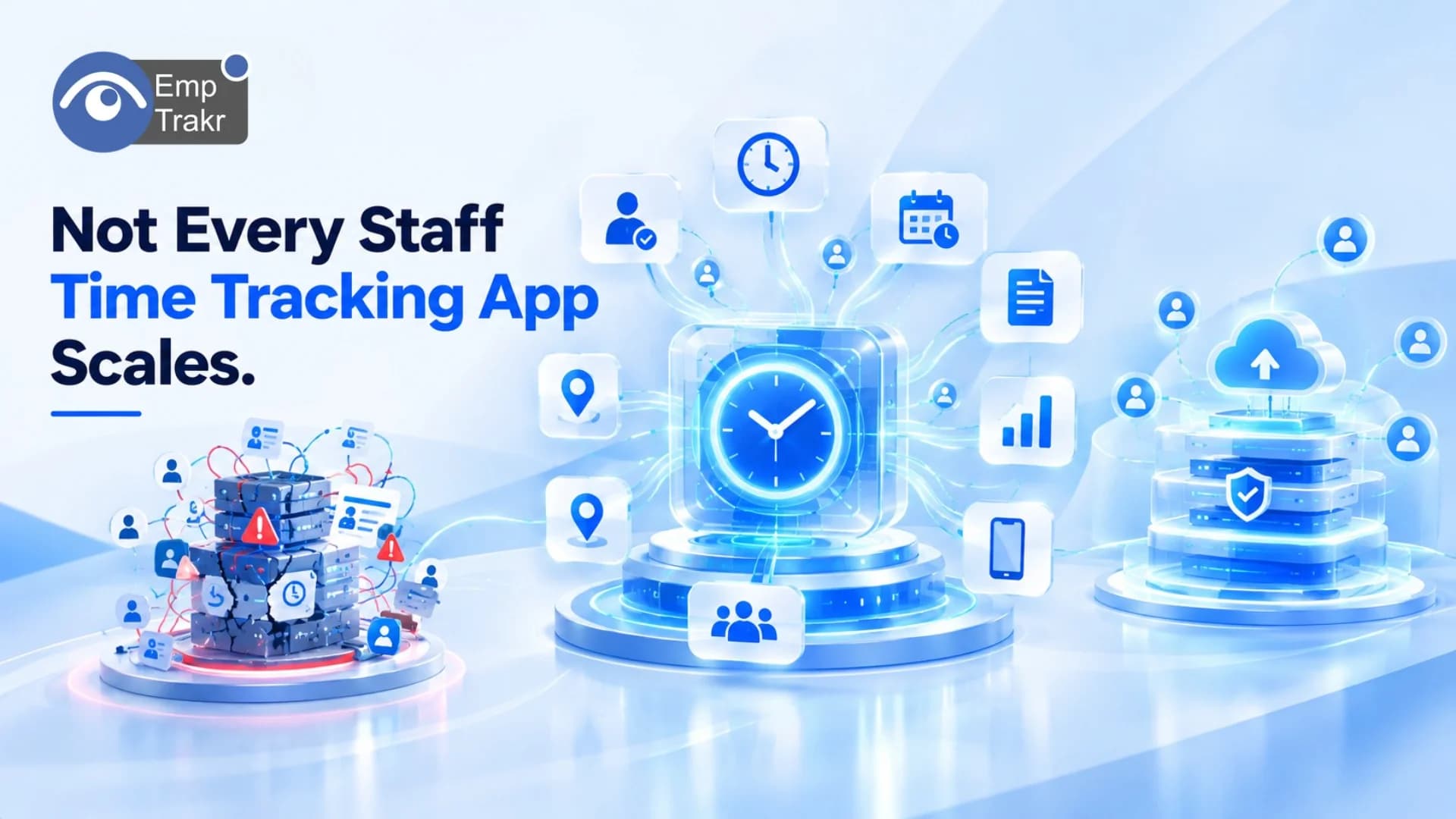
A Staff time tracking app Can look simple from the outside: employees clock in, clock out, and managers review the hours.
But once a team grows, basic clock-in functionality isn't always enough.
Managers may need accurate working-hour records, attendance visibility, shift information, reports, productivity context, and a system that remains easy to use across different teams.
The difference between a basic clock app and a useful staff time tracking solution often comes down to Accuracy, usability, reporting, scalability, and how well the app fits the team's actual workflow.
Quick Answer
A good staff time tracking app should make it easy to:
Record employee working hours
Track clock-in and clock-out
Manage breaks
Review attendance
Understand staff schedules
Generate timesheet reports
Monitor productivity when appropriate
Scale as the team grows
Manage employee data responsibly
For businesses that need more than basic time records, combining time tracking with Attendance tracking And Productivity tracking Can provide a broader view of workforce activity.
What Is a Staff Time Tracking App?
A staff time tracking app is software that records employee working time digitally.
Instead of relying on paper timesheets or manually maintained spreadsheets, employees can record their working sessions through an app or software platform.
Depending on the system, it may record:
Clock-in time
Clock-out time
Total working hours
Breaks
Overtime
Attendance
Timesheets
Activity information
For businesses with remote, hybrid, shift-based, or distributed teams, digital time tracking can reduce manual administration.
A dedicated Time tracking software Solution can also provide managers with a centralized view of employee working hours.
Why Basic Clock Apps Aren't Always Enough
A simple clock-in and clock-out feature may work for a very small team.
But as the number of employees increases, additional questions appear:
Who was working?
When did they start?
How many hours were recorded?
Were breaks taken correctly?
Are schedules being followed?
Can managers generate reports without manually combining spreadsheets?
Will the system still work when the team doubles?
A good staff time tracking app should reduce these administrative problems rather than create new ones.
7 Features That Separate Better Staff Time Tracking Apps
1. Simple Clock-In and Clock-Out
The most important feature should also be one of the easiest to use.
Employees shouldn't need to navigate through multiple screens just to start tracking their work.
A practical app should make clock-in and clock-out straightforward while maintaining accurate records.
For businesses managing remote or distributed staff, simplicity can also improve adoption because employees are less likely to forget or avoid using the system.
2. Accurate Working-Hour Records
Time tracking is only useful when the underlying records are reliable.
A good system should make it easy to review:
Start time
End time
Breaks
Total hours
Daily totals
Weekly totals
This information can then be used for timesheets, workforce planning, and operational reporting.
Businesses should also check how the software handles edited or corrected time entries.
3. Attendance Visibility
Time tracking doesn't necessarily answer every attendance question.
For example, an employee could have eight recorded working hours, but a manager may also need to understand whether those hours matched the expected schedule.
That's where Attendance tracking Becomes useful.
Attendance functionality can help businesses manage:
Check-ins
Check-outs
Working schedules
Attendance records
Absence information
Combining attendance and time tracking can reduce the need for separate systems.
4. Useful Reporting
A staff time tracking app shouldn't just collect data.
It should help turn that data into information managers can understand.
Useful reports may include:
| Report | What It Helps Show |
|---|---|
| Daily hours | Hours recorded each day |
| Weekly timesheet | Total weekly working time |
| Attendance | Staff presence and schedules |
| Break report | Recorded breaks |
| Employee summary | Individual time patterns |
| Team summary | Workforce-level patterns |
| Activity report | Broader work activity |
Reporting becomes particularly important as teams grow.
Manually reviewing hundreds of time entries isn't an efficient way to manage workforce information.
5. Support for Growing Teams
A staff time tracking app may work well with ten employees and become difficult at fifty.
That's why scalability should be considered before implementation.
Check:
Maximum employees
User management
Team or department organization
Reporting capacity
Data retention
Pricing structure
Administrative controls
A platform that becomes difficult to manage as your workforce grows can create more work instead of reducing it.
6. Productivity Context
Time tracking tells you How long Someone worked.
It doesn't necessarily tell you What was happening during that time.
For businesses that need additional context, Productivity tracking Can provide information about activity patterns.
Depending on the software, this can include:
Active time
Idle periods
Application activity
Work patterns
Productivity reports
However, these signals should not automatically be treated as a complete measure of employee performance.
Different jobs naturally have different activity patterns.
A developer, designer, salesperson, and customer-support employee may all use their computers differently while performing their jobs effectively.
7. Application Activity
For some businesses, application activity can provide useful context around recorded working time.
Live app tracking Can help managers understand which applications are being used during work periods.
For example, a business may want to understand whether employees are spending most of their working time in:
CRM platforms
Project-management software
Communication applications
Development tools
Design software
The purpose should be to understand workflow patterns rather than judge employees based on individual application events.
Staff Time Tracking App Comparison Checklist
Before choosing an app, compare the capabilities that matter to your team.
| Feature | Basic App | Better-Suited Solution |
|---|---|---|
| Clock-in/out | Yes | Yes |
| Working-hour records | Yes | Yes |
| Timesheets | Sometimes | Yes |
| Attendance | Limited or separate | Integrated |
| Break tracking | Varies | Available |
| Reporting | Basic | Detailed |
| Team management | Limited | Scalable |
| Productivity context | Often unavailable | Available |
| App activity | Often unavailable | Available where needed |
| Privacy controls | Varies | Clearly documented |
| Scalability | Varies | Designed for growing teams |
The point isn't that every business needs every feature.
The better approach is to match the software to the actual requirements of the workforce.
Mobile Staff Time Tracking Matters
For some teams, mobile accessibility is important.
Shift-based or distributed staff may not spend the entire day at a traditional desk.
A mobile-friendly time tracking experience can make it easier for employees to record working time without depending on a desktop workstation.
This is particularly relevant for businesses with:
Multiple shifts
Distributed employees
Flexible schedules
Remote workers
Employees moving between work locations
However, businesses should verify the actual mobile capabilities of each provider rather than assuming that every staff time tracking app works the same way on mobile devices.
What About Screenshot Monitoring?
Some workforce monitoring platforms offer screenshots alongside time and activity tracking.
This can provide additional visual context, but it isn't automatically necessary for every team.
If the business only needs working-hour records, a standard time tracker may be sufficient.
If there is a specific operational reason for screenshots, Screenshot monitoring May provide an additional layer of information.
The key consideration is purpose.
Businesses should determine whether screenshots are actually necessary and communicate monitoring practices clearly to employees.
Privacy Should Be Part of the Evaluation
A good staff time tracking app shouldn't only be evaluated by its feature list.
Businesses should also understand:
What information is collected
Why it is collected
Who can access it
How long it is retained
What employees are told
What privacy controls are available
The UK's Information Commissioner's Office (ICO) recommends that worker monitoring should have a clear purpose and be necessary and proportionate. It also recommends considering less intrusive ways of achieving the same objective.
For businesses considering employee monitoring, EmpTrakr's Security & Privacy information can be reviewed alongside the product features.
Staff Time Tracking for Remote and Hybrid Teams
Remote work makes reliable time and attendance information more important for some organizations.
Managers may not have the same visibility they would have in a shared physical office.
A staff time tracking app can centralize information such as:
Working hours → Attendance → Activity → Reports
This can reduce reliance on manual updates and give managers a consistent source of workforce information.
But the software should support management rather than encourage unnecessary monitoring.
The objective should be to understand work patterns and operational requirements.
When Should You Upgrade From a Basic Clock App?
A basic clock app may be sufficient when you only need:
Clock-in
Clock-out
Total hours
Simple timesheets
A more comprehensive solution may become useful when you need:
Attendance management
Team reporting
Productivity information
Application activity
Centralized employee management
Scalable reporting
This is where an integrated platform can reduce the need to maintain several separate systems.
EmpTrakr combines Employee monitoring software With time, attendance, productivity, and activity-related features.
How to Choose a Staff Time Tracking App
Before making a decision, work through this checklist.
1. Identify the main purpose
Are you trying to track working hours, attendance, shifts, productivity, or all of these?
2. Check employee capacity
Make sure the platform can support your current workforce and expected growth.
3. Test usability
Employees should be able to start and stop tracking without unnecessary complexity.
4. Review reporting
Make sure managers can access the information they actually need.
5. Check mobile support
If staff work away from desks, verify whether mobile tracking is supported.
6. Review additional monitoring
Check whether app activity or screenshots are available and whether you actually need them.
7. Review privacy practices
Understand what data is collected and how it is handled.
EmpTrakr as a Staff Time Tracking Solution
EmpTrakr brings several workforce-management capabilities together instead of treating time tracking as an isolated feature.
Teams can explore:
This gives businesses the option to begin with core time and attendance requirements and use additional functionality when it serves a clear purpose.
Final Thoughts
A Staff time tracking app Shouldn't be judged only by whether it can clock employees in and out.
The better questions are:
Is it easy to use?
Are the time records reliable?
Can managers understand the data?
Does it support attendance and reporting?
Can it scale with the team?
Does it provide additional context when needed?
Are its monitoring and privacy practices clear?
For a very small team, a basic clock app may be enough. For a growing workforce, combining Time tracking, attendance, reporting, productivity, and activity visibility Can create a more complete workforce-management system.
The goal isn't to track every possible employee action.
It's to make staff hours Easier to record, understand, and manage.
Sources
-
U.S. Department of Labor — FLSA Recordkeeping Requirements
U.S. Department of Labor — Recordkeeping Requirements -
UK Information Commissioner's Office (ICO) — Monitoring Workers
ICO — Monitoring Workers -
NIST — Data Minimization
NIST — Data Minimization
Frequently Asked Questions
What is a staff time tracking app?
What features should a good staff time tracking app have?
Can a staff time tracking app track attendance?
Is a staff time tracking app useful for remote teams?
Can staff time tracking software track application activity?
Related EmpTrakr resources
Continue with product pages that match this topic — and explore more guides on the blog.
Supercharge your workforce today.
Join leading companies using EmpTrakr to boost productivity, streamline tracking, and optimize remote teams.