Shadow AI Monitoring: Improve Workplace AI Governance
Discover how Shadow AI monitoring helps businesses identify AI usage, understand employee activity, improve workplace security and support AI governance.
In This Guide11 Sections
- 01Bridging the Shadow AI Gap: How Employee Activity Data Turns AI Usage into Actionable Governance
- 02Why shadow AI is a growing concern for business leaders
- 03Why traditional approaches leave gaps in AI visibility
- 04How employee activity data adds visibility
- 05Four steps to turn AI usage visibility into actionable governance
- 06Step 1: Establish a baseline of real-world AI usage
- 07Step 2: Classify tools and assess potential risks
- 08Step 3: Investigate unfamiliar activity before taking action
- 09Step 4: Monitor usage trends and document governance decisions
- 10From AI visibility to informed governance
- 11Sources and References
Bridging the Shadow AI Gap: How Employee Activity Data Turns AI Usage into Actionable Governance
Learn how employee activity data that identifies AI application usage reveals adoption patterns and supports better decisions about workplace security, productivity and compliance.
Organizations need visibility into which AI tools employees actually use — not just those IT has approved or procurement has purchased. EmpTrakr helps organizations understand employee application usage, activity patterns and productivity, providing insights that can support more informed decisions about AI adoption, workplace governance and security.
As AI applications become part of everyday workflows, organizations need to understand how employees use these tools, where adoption is growing and whether existing workplace policies adequately address their use.
Key takeaways:
Shadow AI creates potential security, privacy and compliance risks.
Traditional software inventories leave gaps in AI application visibility.
Employee activity data reveals application usage and adoption patterns.
Context is essential when investigating unfamiliar AI applications.
Continuous application monitoring supports informed workplace governance.
Why shadow AI is a growing concern for business leaders
Shadow AI is becoming an important concern for business leaders. CEOs, IT managers, HR teams and security professionals increasingly face a common challenge: employees are adopting AI applications faster than organizations can review and approve them.
Consider some of the risks organizations face when employees use AI applications without appropriate oversight:
Employees may share confidential customer information with external AI applications.
Developers may upload proprietary code to AI tools without understanding their data-handling policies.
Employees may install AI browser extensions that process company information through third-party services.
Teams may adopt AI applications that have not been reviewed for security or privacy requirements.
These situations do not necessarily mean employees intend to create security problems. Often, employees simply want to complete their work more efficiently.
However, organizations can face serious consequences when business information is shared with applications that have not been appropriately evaluated.
IBM's 2025 Cost of a Data Breach research reported that organizations experiencing breaches involving shadow AI faced additional breach costs. The research highlights why organizations need to understand AI adoption and establish appropriate governance.
Business leaders face a growing challenge: How do you encourage productive AI adoption while managing risks you may not know exist?
Addressing Shadow AI requires more than blocking applications or updating acceptable-use policies. It starts with understanding how employees actually use AI applications during work.
EmpTrakr's Employee monitoring software Helps organizations understand workplace activity and application usage within their configured monitoring environment, supporting better visibility into how digital tools are used.
Why traditional approaches leave gaps in AI visibility
Shadow AI refers to AI applications used for work purposes without appropriate organizational review, approval or oversight.
Picture an employee using a personal AI account to complete work tasks — such as feeding customer notes into a chatbot for a quick summary or asking an AI assistant to generate a section of code.
Other examples of Shadow AI include installing an AI browser extension that processes company information through a third-party service or using an external AI application to summarize internal documents.
Companies typically rely on several sources to understand which AI tools employees use:
Procurement records and approved tool lists Identify applications an organization has purchased or authorized, but they may not reflect applications employees independently adopt.
Employee surveys and manual registries Provide useful information about AI adoption but depend on employees knowing, remembering and reporting which applications they use.
Network security tools Identify traffic to known AI services within their coverage, but may not capture activity outside monitored networks or on unmanaged devices.
AI gateways Provide detailed information about interactions passing through connected AI services, but may not cover applications employees access independently.
Employee application monitoring Provides visibility into application usage within its configured monitoring scope, but does not automatically reveal what information employees submitted to an AI service.
Each approach serves an important purpose, but none provides a complete picture of AI adoption on its own.
As AI applications continue to evolve, keeping track of tools through outdated procurement lists and periodic audits becomes increasingly difficult.
Organizations need visibility into how AI applications are actually used, so they can compare application activity with approved software, existing policies and business requirements.
EmpTrakr's Live App Tracking Helps organizations understand application usage and identify activity patterns within their monitoring environment.
This information can support application reviews and help businesses understand which tools employees rely on during everyday work.
How employee activity data adds visibility
Employee activity data shows how work gets done across digital systems: how teams use applications, interact with software and organize their workflows.
It can reveal which applications employees use, how frequently they use them and how those patterns change over time.
This brings application usage into view, helping organizations identify unfamiliar applications and understand how adoption evolves naturally.
Rather than relying on guesswork, organizations can use these insights to answer practical questions:
Which AI applications need further review or approval?
Where is AI adoption concentrated across teams and departments?
Which applications are part of regular workflows versus occasional experiments?
How does actual application usage compare with approved tools and existing software investments?
Which applications may require additional employee guidance or security review?
These insights help organizations determine where to focus attention.
A newly detected application used briefly by a small group may warrant a different response than an unfamiliar application used regularly across multiple departments.
They can also reveal where employees find value in AI, helping leaders decide which tools to officially support or where safer alternatives may be needed.
EmpTrakr's Productivity Tracking Helps organizations understand employee application activity and workplace productivity patterns.
By reviewing application usage alongside work responsibilities and business context, organizations can better understand how digital tools fit into everyday workflows.
Four steps to turn AI usage visibility into actionable governance
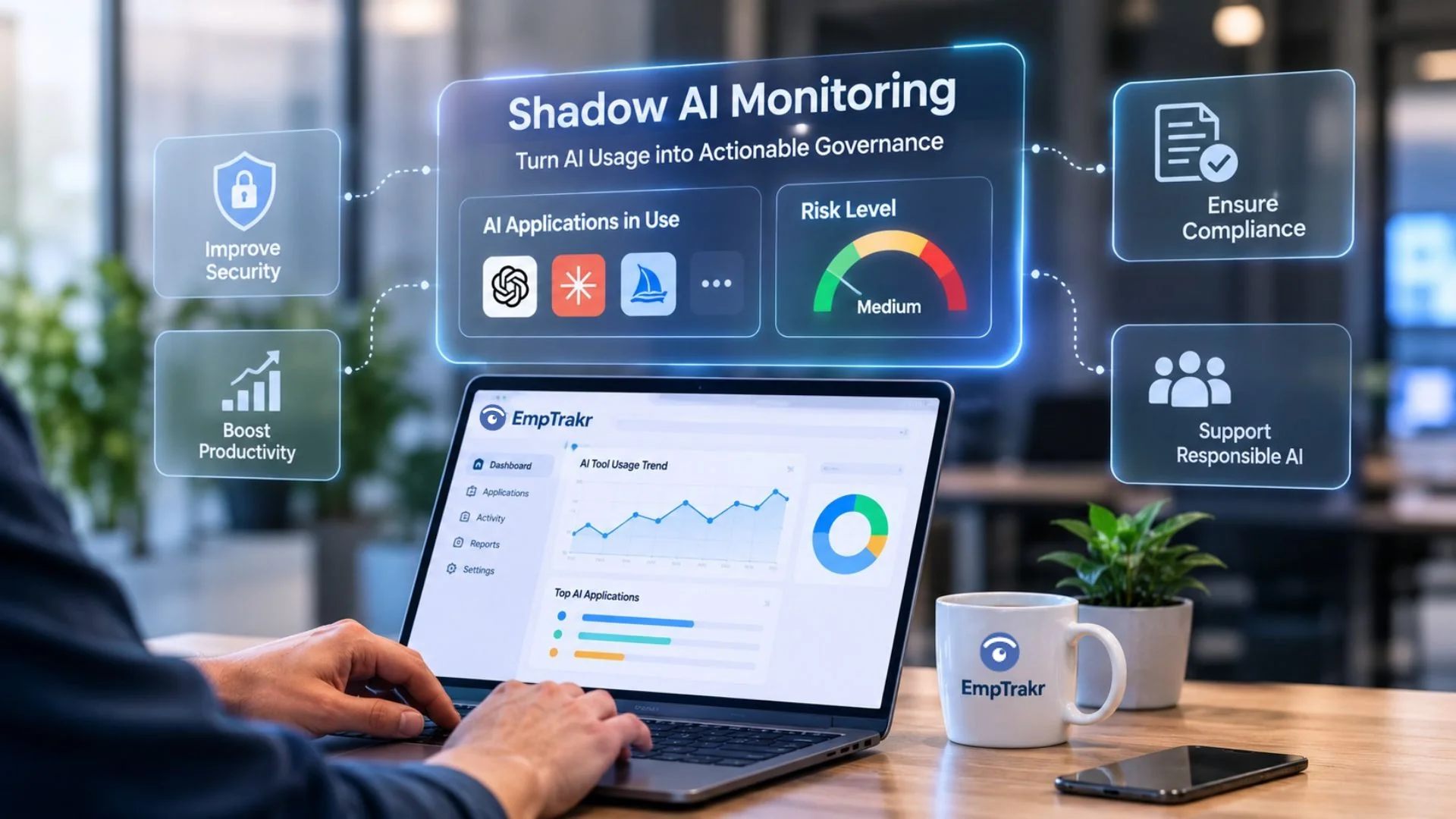
Having a clearer picture of AI application usage is a great starting point, but visibility alone will not protect company information.
The real challenge is turning application activity data into a repeatable process for reviewing tools, managing risks and monitoring changes over time.
Step 1: Establish a baseline of real-world AI usage
Start by understanding which AI applications employees use every day, including applications that IT has not approved.
Look at application usage by department and team, including how frequently employees use each application and how usage patterns change.
When you compare actual application activity against procurement records, you can identify applications that may need formal review.
This baseline helps organizations understand the scale of AI adoption before deciding which applications to approve, restrict or investigate.
Widespread adoption of an unapproved application is not always a security warning. It may indicate that employees have discovered a legitimate gap in the organization's existing software.
For example, employees may use an AI writing assistant because the approved application does not provide the features they need.
Understanding this behavior helps organizations determine whether the application should be reviewed, whether an approved alternative is available or whether existing software investments need reconsideration.
EmpTrakr's Employee Monitoring Software Provides application and workplace activity visibility that can help organizations understand employee software usage within their monitoring scope.
Step 2: Classify tools and assess potential risks
Once you understand which AI applications are being used, establish a consistent review process.
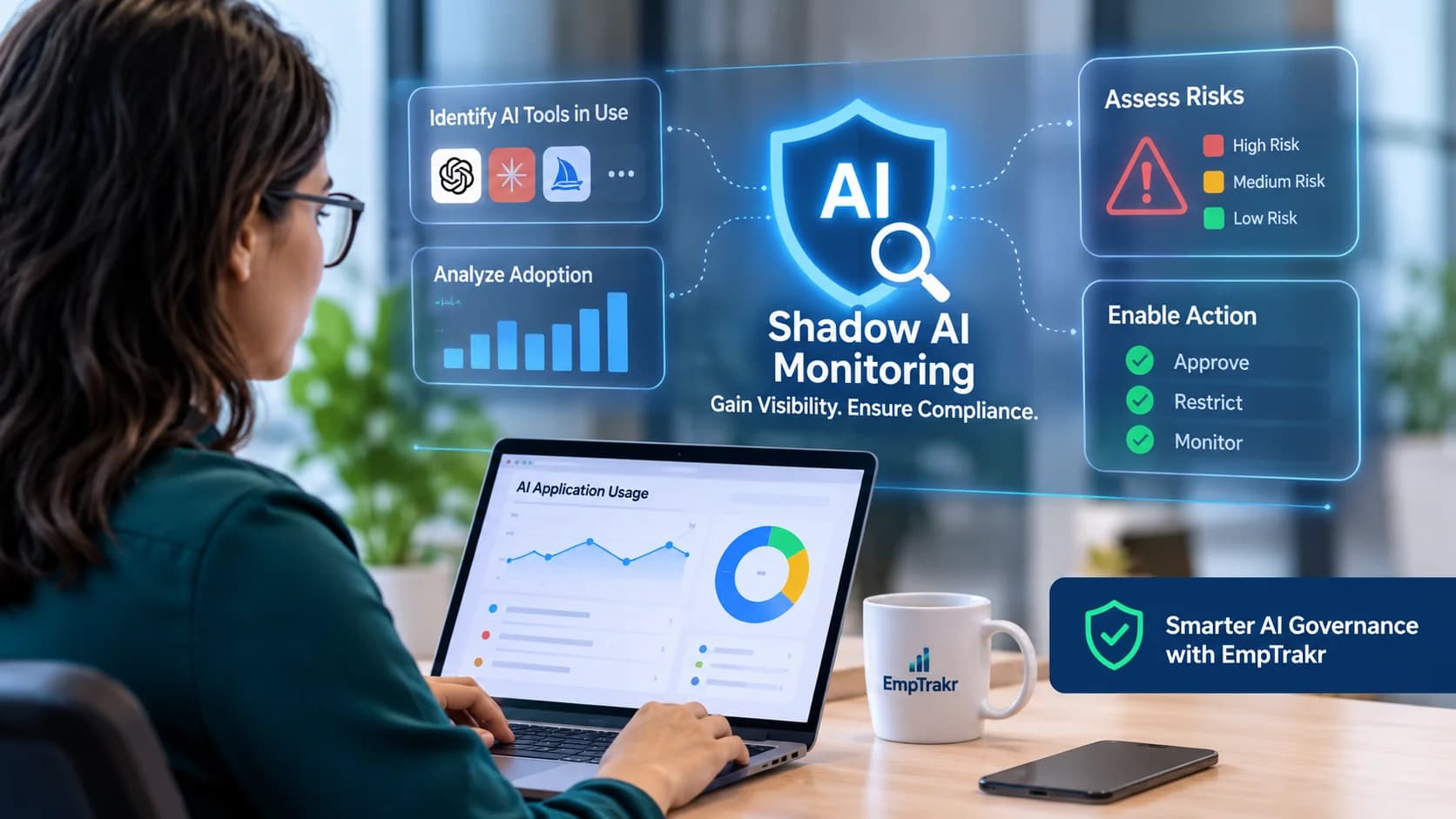
Sort applications into three categories: approved, unapproved and awaiting review.
Approval status alone does not establish risk.
You also need to consider the application's capabilities, the information employees may handle and the security controls available.
Low Risk: An employee uses an external AI application to brainstorm general marketing ideas without sharing confidential business information.
High Risk: An employee uploads proprietary customer contracts to a public AI application to generate a summary without appropriate organizational approval.
These examples illustrate why application usage needs context.
An application used for general research may require a different review from an application used to process confidential customer information.
Employee activity data can help organizations prioritize application reviews by showing where usage is increasing or where unfamiliar tools are becoming part of regular workflows.
However, organizations should use additional security and privacy assessments to determine the actual risk associated with each application.
EmpTrakr's Productivity Tracking And Live App Tracking Features can help businesses understand application usage patterns and identify where further review may be useful.
Step 3: Investigate unfamiliar activity before taking action
Not every unapproved AI application requires an immediate restriction.
Understanding why and when an application was used can help organizations distinguish legitimate experimentation from ongoing security concerns.
Real-world example: Imagine a company's development team suddenly begins using an unfamiliar AI application.
The application usage data shows increased activity among several employees.
At first, this may appear to be a potential Shadow AI concern.
However, further investigation reveals that the activity occurred during an internal hackathon.
The employees were experimenting with a new application for a temporary project rather than incorporating an unreviewed tool into their daily workflows.
The organization can then evaluate the application, determine whether it meets security requirements and decide whether it should be approved for future use.
This approach helps businesses avoid making decisions based on incomplete information.
It also allows organizations to support employee innovation while maintaining appropriate workplace policies.
EmpTrakr's Screenshot Monitoring Can provide additional workplace activity context when configured and used appropriately.
Organizations should establish clear policies governing screenshot collection, access and retention.
Screenshots should not be treated as automatic evidence of misconduct. Application activity, employee responsibilities and relevant business context should be considered before taking action.
Step 4: Monitor usage trends and document governance decisions
As new AI applications emerge and employee usage patterns change, organizations need continuous visibility paired with documented decision-making.
To keep this process running smoothly, assign clear ownership for AI application reviews and track relevant governance metrics.
Applications detected vs. Reviewed: Total applications identified compared with applications assessed.
Approval velocity: The average time it takes to review an application or resolve an approval request.
Assessment completeness: The percentage of applications requiring review that have completed an appropriate assessment.
Application adoption trends: Changes in application usage across teams and departments.
Policy coverage: Whether employees have received relevant AI acceptable-use guidance.
These metrics help organizations understand whether their governance process is working effectively.
They should support application reviews and organizational decision-making rather than serve as standalone employee performance measurements.
EmpTrakr's Employee Monitoring Software And Productivity Tracking Can help organizations understand workplace activity and application usage trends within their configured monitoring environment.
For organizations that use screenshots as part of their monitoring policies, Screenshot Monitoring Provides an additional source of workplace activity information.
From AI visibility to informed governance
The goal of AI governance is not to crush innovation or stop employees from experimenting with AI.
It is about getting enough visibility to make informed decisions.
With a clearer understanding of actual application usage and workplace activity, organizations can identify applications that need review, support employees who discover useful tools and improve their approach to responsible AI adoption.
However, application monitoring alone cannot guarantee data security or regulatory compliance.
Organizations should combine application usage insights with security assessments, employee education, appropriate access controls and transparent workplace policies.
As AI becomes deeply woven into everyday workflows, finding the balance between security, employee productivity and responsible innovation becomes increasingly important.
EmpTrakr helps organizations understand workplace activity through employee monitoring, application tracking and productivity insights.
Explore EmpTrakr's employee monitoring software To learn how application visibility can support informed workplace decisions.
Sources and References
1. IBM – Cost of a Data Breach Report 2025
Useful for discussing data breach costs and security risks involving Shadow AI.
2. NIST – Artificial Intelligence Risk Management Framework
NIST AI Risk Management Framework
Supports responsible AI adoption, risk assessment and governance.
3. CISA – Artificial Intelligence Resources
CISA Artificial Intelligence Resources
Useful for discussing AI security considerations and organizational risk management.
4. OWASP – Top 10 for Large Language Model Applications
Supports discussion of AI application vulnerabilities and security risks.
5. NIST – Privacy Framework
Supports employee privacy, data protection and responsible monitoring practices.
Frequently Asked Questions
What is Shadow AI monitoring?
Why is Shadow AI a security risk for businesses?
How can businesses identify unauthorized AI applications?
Can employee monitoring help prevent Shadow AI?
How does AI governance improve workplace productivity?
How does EmpTrakr support employee application monitoring?
Explore Further
Related EmpTrakr Resources
Continue with product pages that match this topic — and explore more guides on the blog.
A More Focused Workday Starts Here
Turn Insight Into Better Workdays.
Give teams the clarity they need with simple time tracking, activity insights, and flexible reporting.