AI Productivity: Measure Results, Not AI Usage
Discover why AI usage metrics can mislead businesses and how to measure real productivity through workflow efficiency and business outcomes.
In This Guide7 Sections
- 01AI Productivity Is Not About Using More Tokens: Measure Real Business Outcomes
- 02Why AI Usage Metrics Can Be Misleading
- 03AI Activity vs Actual Productivity
- 04Five Metrics Businesses Should Measure Instead
- 05How Workforce Data Supports Better Productivity Decisions
- 06Avoid Measuring Productivity Through Pressure
- 07Final Thoughts: Measure Results, Not AI Usage
AI Productivity Is Not About Using More Tokens: Measure Real Business Outcomes
AI is changing how employees work. From writing reports and analyzing data to managing emails and automating repetitive tasks, businesses are increasingly adopting AI tools to improve productivity.
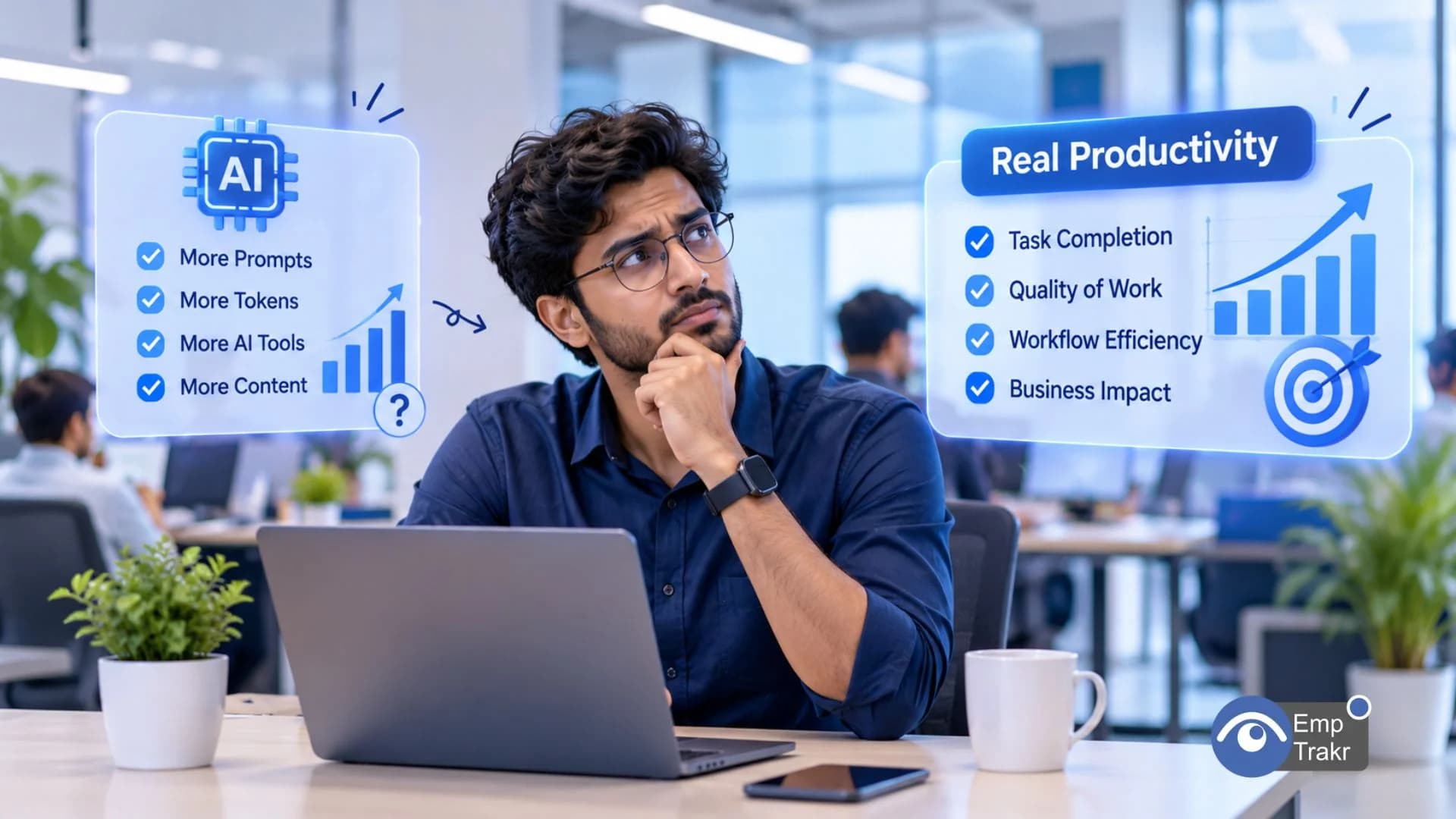
However, a new problem is emerging: many organizations are measuring AI success through token consumption, prompt volume, and tool usage instead of actual business results.
Using more AI does not automatically mean working better.
An employee generating thousands of AI tokens may not be more productive than someone who uses AI selectively and consistently delivers quality work. Businesses need to focus on outcomes rather than usage numbers.
Why AI Usage Metrics Can Be Misleading
AI usage metrics show how frequently employees interact with AI tools, but they do not explain whether those interactions create meaningful value.
For example, one employee may generate multiple AI drafts throughout the day, while another uses AI once to complete a task efficiently.
Measuring productivity through prompt volume would make the first employee appear more active, even if the second delivers better results.
Some commonly misleading metrics include:
Token consumption: Higher usage does not guarantee better output.
Prompt volume: More prompts may indicate unnecessary repetition.
AI adoption rates: Using AI tools does not prove improved performance.
Generated content: More output does not always mean higher quality.
These indicators can help measure adoption, but they should not become the primary measures of business success.
AI Activity vs Actual Productivity
AI activity measures how frequently employees use technology. Actual productivity measures how effectively they complete meaningful work.
Consider a marketing employee using AI to generate content. Although the initial draft may take only a few minutes, reviewing, correcting, and verifying the information still requires time.
Therefore, businesses should evaluate the complete workflow rather than just the speed of AI-generated output.
| AI Usage Metric | Better Productivity Metric |
|---|---|
| Number of prompts | Time saved |
| Tokens consumed | Business value generated |
| Tools adopted | Workflow improvement |
| Content generated | Content quality |
| Tasks automated | Reduction in repetitive work |
The goal is to understand whether AI makes everyday operations more efficient.
Five Metrics Businesses Should Measure Instead
Businesses should focus on measurable improvements rather than encouraging employees to maximize AI usage.
1. Task Completion Time: Compare how long employees take to complete similar tasks before and after introducing AI.
2. Work Quality: Evaluate accuracy, revisions, error rates, and the quality of completed work.
3. Workflow Efficiency: Identify whether AI reduces repetitive activities or introduces additional verification and correction work.
4. Employee Activity: Understand how employees distribute their working time across applications and activities. Tools such as Employee Monitoring Software And Productivity Tracking Can provide useful visibility into workplace activity.
5. Business ROI: Compare AI software costs, implementation expenses, time savings, and improvements in operational performance.
How Workforce Data Supports Better Productivity Decisions
AI productivity cannot be understood through AI dashboards alone. Businesses also need visibility into how employees work.
For example, frequent application switching, repetitive administrative tasks, and inefficient time allocation can affect productivity even when employees have access to advanced AI tools.
EmpTrakr helps organizations understand these workplace patterns through several capabilities:
Live App Tracking Provides visibility into application usage and digital work activity.
Time Tracking Software Helps organizations understand how working time is allocated.
Attendance Tracking Supports attendance management and clearer workforce records.
Screenshot Monitoring Provides additional visual context about workplace activity, subject to appropriate privacy practices.
These features do not directly calculate AI ROI. Instead, they provide complementary workforce insights that help managers understand operational patterns and identify opportunities for improvement.
Avoid Measuring Productivity Through Pressure
One common mistake is rewarding employees simply for using AI more frequently.
If employees are evaluated on prompt volume or token consumption, they may start using AI unnecessarily to improve their numbers.
Instead, businesses should establish clear objectives, communicate monitoring policies, consider employee feedback, and evaluate meaningful work outcomes.
Productivity data should support better decisions, not create unnecessary workplace pressure.
Final Thoughts: Measure Results, Not AI Usage
AI adoption is only valuable when it helps businesses improve the way work gets done.
High token consumption, frequent prompts, and increased AI-generated content cannot independently demonstrate business success.
Organizations should focus on task efficiency, work quality, workflow improvements, employee activity, and measurable business outcomes.
With workforce visibility through EmpTrakr, businesses can better understand employee activity, attendance, application usage, and working-time patterns.
The goal is not to use more AI. The goal is to make work better.
Frequently Asked Questions
What is tokenmaxxing in AI?
Why is AI usage not a reliable productivity metric?
How should businesses measure AI productivity?
Can employee monitoring software help measure productivity?
What is the difference between AI adoption and AI productivity?
Explore Further
Related EmpTrakr Resources
Continue with product pages that match this topic — and explore more guides on the blog.
A More Focused Workday Starts Here
Turn Insight Into Better Workdays.
Give teams the clarity they need with simple time tracking, activity insights, and flexible reporting.