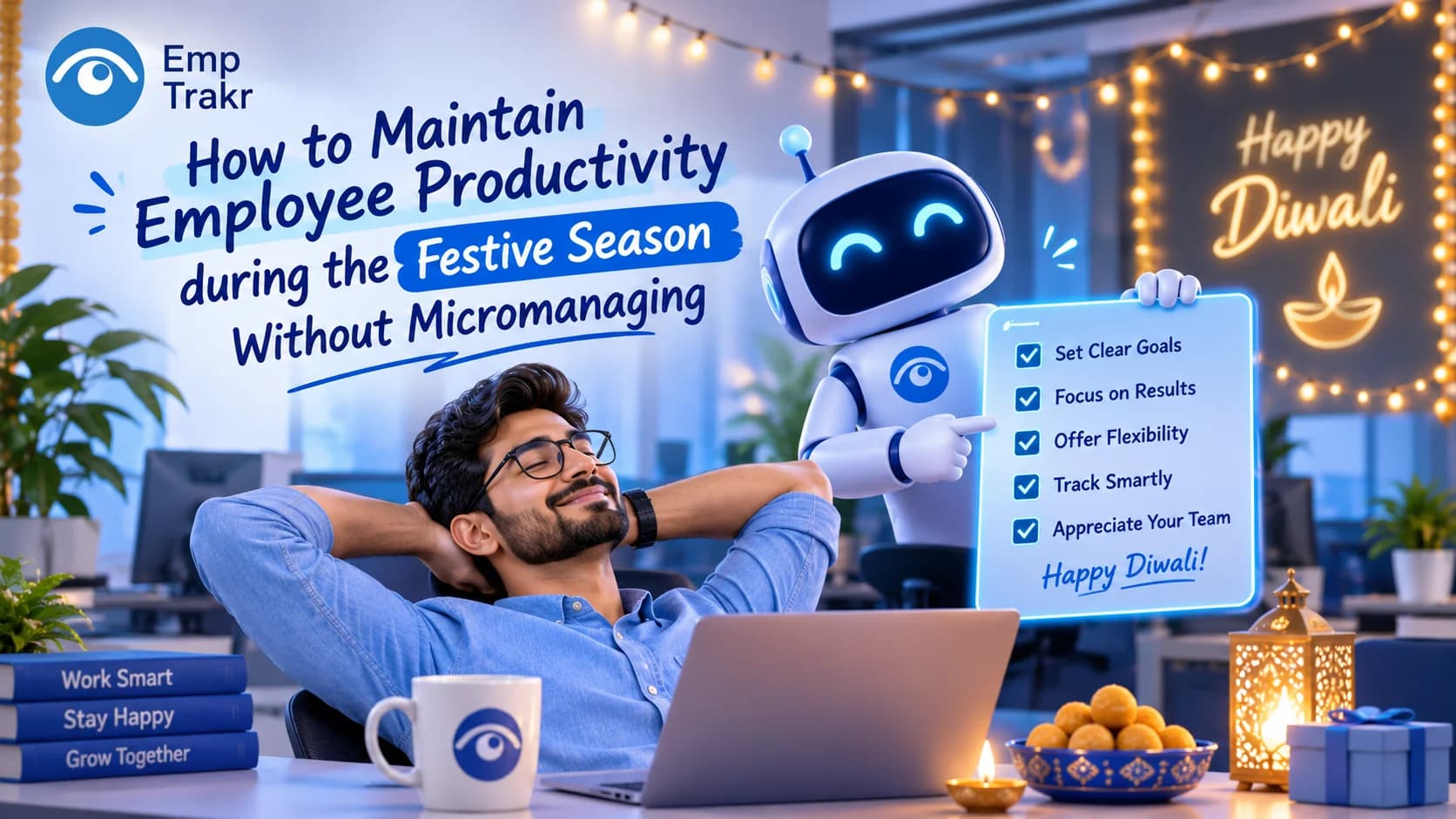
Employee Productivity During Festive Season: 7 Tips
Discover how to maintain employee productivity during Diwali without micromanaging. Explore practical tips for happier teams and smarter work management.
In This Guide10 Sections
- 01How to Maintain Employee Productivity During the Festive Season Without Micromanaging
- 02Introduction:
- 031. Set Clear Deadlines Before the Festive Rush
- 042. Focus on Results, Not Every Online Minute
- 053. Give Employees Flexibility During Festive Season
- 064. Understand App Usage Without Becoming the Office Detective
- 075. Don't Confuse Monitoring with Micromanagement
- 086. Recognize Employees Beyond Their Productivity Numbers
- 097. Use Productivity Insights to Improve Workflows
- 10Final Thoughts:
How to Maintain Employee Productivity During the Festive Season Without Micromanaging
Introduction:
It's Diwali Season, Not Deadline Season!
Diwali is around the corner. Employees are planning celebrations, shopping for gifts, decorating their homes, and probably checking their holiday calendars every few hours.
Meanwhile, managers are checking something else: pending tasks, project deadlines, attendance records, and productivity reports.
Sounds familiar?
Festive seasons can make workplace productivity a little unpredictable. Employees have personal commitments, teams may take leave, and work schedules can become less consistent.
But here's a thought: Does maintaining productivity really require checking on employees every 30 minutes?
Probably not.
The goal should be to keep work moving without making employees feel like they're participating in a daily attendance investigation.
Let's explore how businesses can maintain employee productivity during the festive season without unnecessary micromanagement.
1. Set Clear Deadlines Before the Festive Rush
One of the biggest productivity challenges during Diwali is last-minute work.
Employees have shopping plans, family commitments, and travel arrangements. Suddenly assigning urgent tasks just before the holidays isn't exactly a recipe for workplace happiness.
Instead, managers should:
Identify important tasks before the festive period.
Set realistic deadlines.
Distribute workloads fairly.
Communicate holiday schedules in advance.
Clear expectations help employees organize their work without constantly asking managers what needs to be completed next.
2. Focus on Results, Not Every Online Minute
Let's be honest. Being online for eight hours doesn't automatically mean someone has been productive for eight hours.
An employee might complete important tasks in less time, while another might spend the entire day switching between applications and meetings.
Measuring productivity only through online availability can create misleading conclusions.
Managers should focus on work patterns, task progress, and meaningful outcomes rather than expecting employees to remain constantly active.
Tools such as EmpTrakr Productivity Tracking Can help teams understand productivity patterns and identify opportunities to improve workflows.
Because being busy and being productive aren't always the same thing.
3. Give Employees Flexibility During Festive Season
Not everyone celebrates Diwali in the same way. Some employees travel, others manage family responsibilities, and remote workers may have different schedules.
Rigid working hours can create unnecessary pressure during an already busy period.
Businesses can consider:
Flexible working hours where practical.
Planned leave arrangements.
Clear communication about availability.
Reasonable workload adjustments.
Flexible schedules don't necessarily mean reduced accountability.
With appropriate Attendance tracking And Time tracking, managers can maintain better visibility into working schedules without repeatedly asking employees to confirm their availability.
4. Understand App Usage Without Becoming the Office Detective
During festive periods, distractions can increase.
A quick shopping search becomes 20 minutes. Checking a festive sale notification turns into browsing five different websites.
And suddenly, that pending report is still pending.
However, constantly questioning employees about their application usage isn't a productive management strategy either.
Businesses can use Live app tracking To understand application usage patterns and distinguish work-related activity from potential distractions.
The purpose should be to identify workflow issues and support better working habits, not to criticize every personal break.
5. Don't Confuse Monitoring with Micromanagement
There's a difference between understanding workplace activity and constantly interrupting employees.
Micromanagement often creates stress, reduces autonomy, and makes employees feel that their managers don't trust them.
Responsible employee monitoring should have clear objectives, transparent policies, and appropriate boundaries.
For example, Screenshot monitoring Can provide additional workplace visibility when organizations have a legitimate need for it.
However, monitoring practices should always respect employee privacy, applicable laws, and company policies.
The objective is better visibility, not turning the workplace into a surveillance environment.
6. Recognize Employees Beyond Their Productivity Numbers
Here's something managers sometimes forget:
Employees aren't productivity scores.
Festive seasons are a good opportunity to appreciate the people behind the work.
A simple thank-you, a thoughtful Diwali gift, a reasonable bonus, or recognition for completed projects can improve workplace morale.
Employee appreciation shouldn't be limited to annual performance reviews.
When employees feel valued, organizations have a better opportunity to build stronger engagement and a healthier working environment.
And no, another motivational email titled "Let's Finish Strong!" doesn't always count as appreciation.
7. Use Productivity Insights to Improve Workflows
Instead of asking employees for constant updates, managers can use workforce insights to understand where work is getting delayed.
For example:
Are employees spending too much time switching between applications?
Are certain working hours more productive than others?
Are workloads distributed fairly?
Are unnecessary meetings affecting focused work?
Are attendance and scheduling issues creating workflow gaps?
These insights can help businesses make informed decisions.
EmpTrakr brings together productivity tracking, time tracking, attendance tracking, live app tracking, and screenshot monitoring to help organizations understand workplace activity.
Its goal is to make workforce visibility more practical while supporting better management decisions.
Final Thoughts:
Let Employees Celebrate Without Losing Sight of Work
Festive seasons shouldn't become productivity emergencies.
Businesses can maintain performance through realistic deadlines, flexible schedules, clear communication, and meaningful productivity insights.
Managers don't need to send 15 follow-up messages every day to understand how work is progressing.
Sometimes, the smarter solution is simply better visibility and better planning.
So this Diwali, let employees enjoy the celebrations, finish their work responsibly, and spend time with their families.
And managers, perhaps give the "quick status update" message a small festive holiday too.
Make productivity smarter, not stressful.
Explore EmpTrakr, a free employee monitoring and productivity tracking solution with unlimited users and no credit card requirement.
Because better workforce management shouldn't come at the cost of employee happiness.
Frequently Asked Questions
How can companies maintain employee productivity during the festive season?
How can managers avoid micromanaging employees during Diwali?
Does employee monitoring improve productivity?
How can remote teams stay productive during festive seasons?
Is EmpTrakr free for employee productivity tracking?
Explore Further
Related EmpTrakr Resources
Continue with product pages that match this topic — and explore more guides on the blog.
A More Focused Workday Starts Here
Turn Insight Into Better Workdays.
Give teams the clarity they need with simple time tracking, activity insights, and flexible reporting.