How Accurate Is Employee Monitoring Software?| EmpTrakr
How accurate is employee monitoring software? Discover common myths, false positives, reliability, idle time detection accuracy, and software limitations.
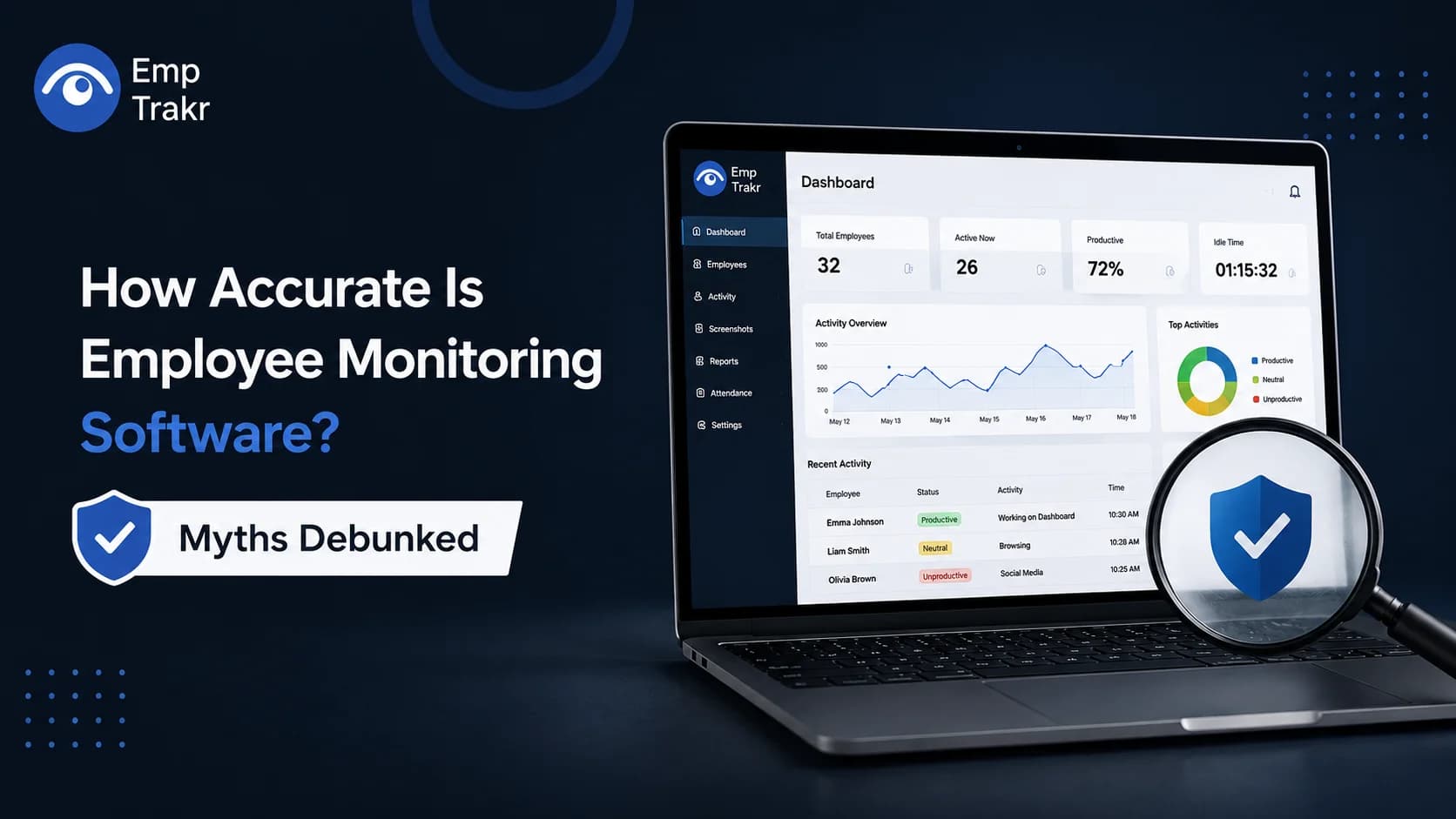
Employee monitoring software accuracy depends on proper configuration, the metrics being tracked, and how businesses interpret the data. Modern solutions accurately measure work-related activities like application usage, active time, and attendance, but they should be used alongside human judgment to avoid false conclusions.
How Accurate Is Employee Monitoring Software? Myths Debunked
As businesses increasingly rely on employee monitoring software to manage remote, hybrid, and office-based teams, one question continues to surface: How accurate is employee monitoring software?
Some believe monitoring tools can perfectly measure productivity, while others assume they generate unreliable data. The truth lies somewhere in between. Modern monitoring platforms provide highly accurate activity data, but no software can fully understand context, work quality, or human behavior on its own.
Understanding employee monitoring software accuracy helps businesses make better decisions, avoid common misconceptions, and use workforce data responsibly.
In this guide, we'll separate myths from facts, explain what monitoring software measures accurately, highlight its limitations, and share best practices for interpreting reports.
Quick Summary
Key Takeaways
- Employee monitoring software accurately records measurable computer activity.
- Productivity metrics should always be interpreted within business context.
- False positives can occur if reports are analyzed without considering job responsibilities.
- Transparency and regular report reviews improve monitoring accuracy.
Table of Contents
- How Accurate Is Employee Monitoring Software?
- What Monitoring Software Measures Well
- Common Myths About Monitoring Accuracy
- Understanding False Positives
- Limitations of Employee Monitoring Software
- Best Practices for Better Accuracy
- Comparison Table
- FAQs
- Conclusion
How Accurate Is Employee Monitoring Software?
Modern employee monitoring platforms are highly accurate when tracking objective computer-based activities such as:
- Active working hours
- Login and logout times
- Application usage
- Website activity
- Keyboard and mouse activity (where enabled)
- Attendance records
- Time spent on specific tasks
Because these metrics are automatically recorded, they provide reliable operational data. However, software cannot determine whether an employee is solving a complex problem, brainstorming ideas, or attending an offline meeting. This is why monitoring reports should always be reviewed alongside business context.
What Monitoring Software Measures Well
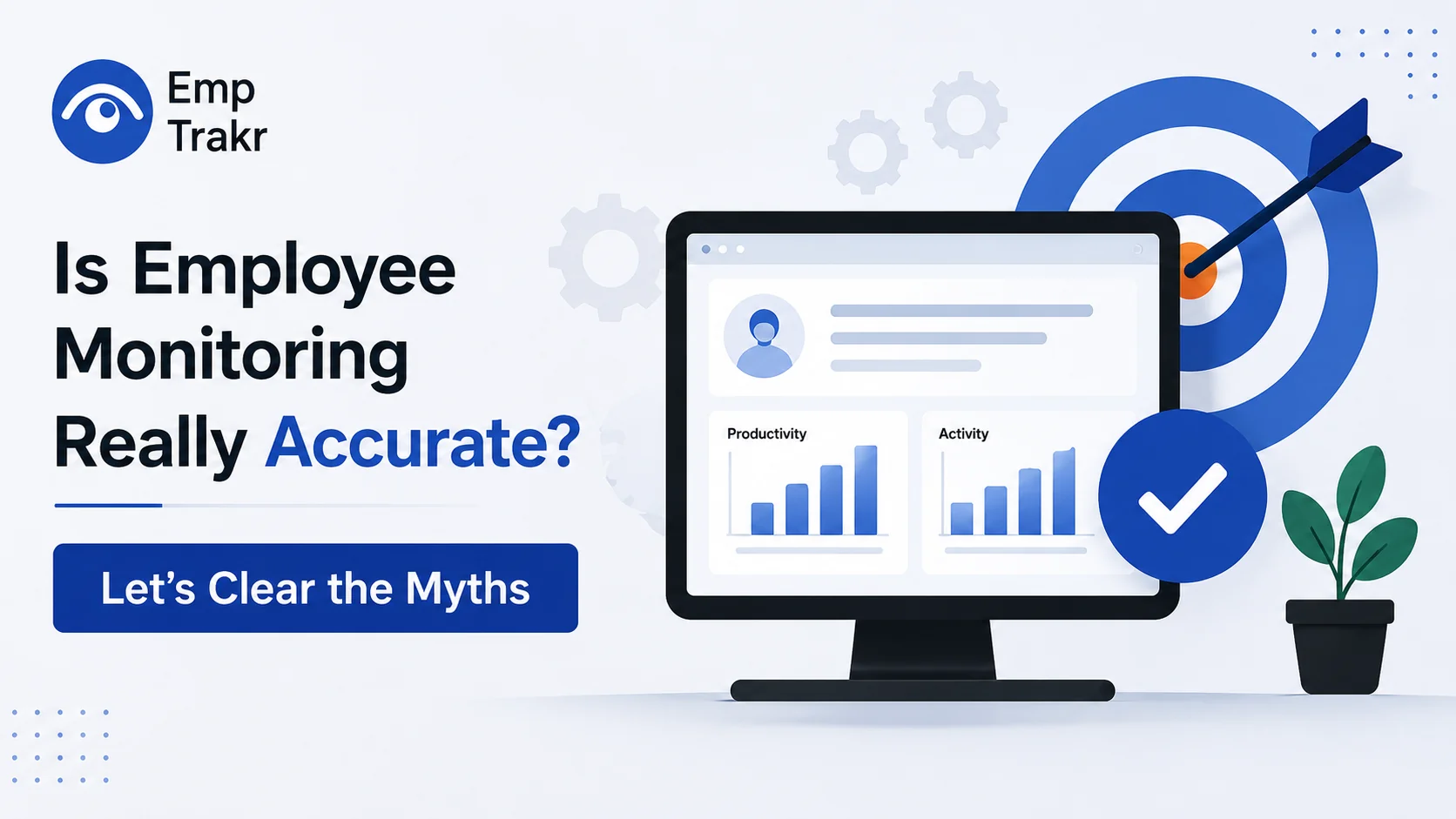
Reliable monitoring software excels at collecting measurable digital activity.
Active Time
Tracks periods when employees actively use their keyboard and mouse. This metric is generally accurate but should not be confused with overall productivity.
Application Usage
Shows exactly which applications are used and for how long, helping managers understand work patterns and software utilization.
Website Activity
Records business-related and non-business websites visited during working hours, supporting productivity analysis and acceptable use policies.
Attendance Tracking
Automatically records login times, logout times, breaks, and total work hours, reducing manual errors in attendance management.
Productivity Reports
By combining multiple metrics, monitoring dashboards provide a more complete picture of employee activity rather than relying on a single data point.
Common Myths About Employee Monitoring Software Accuracy
Myth 1: Monitoring Software Knows How Productive Every Employee Is
Fact: Monitoring software measures activity, not work quality. An employee can spend fewer hours on the computer while delivering exceptional results.
Myth 2: Idle Time Always Means Employees Are Not Working
Fact: The accuracy of idle time detection software depends on how work is performed. Employees may be reading printed documents, attending meetings, making client calls, or brainstorming without using a keyboard or mouse.
Myth 3: Monitoring Software Is Always Wrong
Fact: Modern solutions are technically accurate when collecting digital activity data. Misinterpretation usually happens when managers rely on one metric instead of reviewing complete productivity reports.
Myth 4: More Monitoring Means Better Accuracy
Fact: Capturing excessive data doesn't necessarily improve decision-making. The focus should be on collecting relevant information and analyzing meaningful trends.
Employee Monitoring False Positives
One of the biggest challenges is understanding employee monitoring false positives.
A false positive occurs when monitoring data appears to indicate poor productivity even though the employee is performing legitimate work.
Examples include:
- Participating in client meetings
- Reading technical documentation
- Designing on paper or whiteboards
- Conducting phone calls
- Testing software without continuous keyboard activity
Instead of reacting immediately, managers should review multiple metrics and discuss unusual reports with employees before drawing conclusions.
Employee Monitoring Software Limitations
Although monitoring tools are valuable, they have limitations.
- They cannot measure creativity or critical thinking.
- They don't evaluate the quality of completed work.
- Offline tasks may not appear in activity reports.
- Productivity scores vary depending on configuration.
- Different job roles require different interpretation of monitoring data.
Recognizing these employee monitoring software limitations helps organizations avoid unrealistic expectations.
Best Practices for Better Accuracy
Improve monitoring accuracy by following these best practices:
- Define clear productivity benchmarks.
- Configure monitoring settings for different roles.
- Review trends over weeks rather than individual days.
- Combine monitoring reports with project outcomes.
- Train managers to interpret dashboard data correctly.
- Communicate monitoring policies transparently.
- Regularly review software configurations and reporting rules.
Monitoring software should support better decision-making not replace human judgment.
Comparison Table
| Myth | Reality |
|---|---|
| Monitoring software measures work quality | It measures work-related activity |
| Idle time always means inactivity | Employees may be performing offline tasks |
| One productivity score tells the whole story | Multiple metrics provide better insights |
| More screenshots improve accuracy | Context matters more than quantity |
| Monitoring replaces managers | It supports informed decision-making |
Frequently Asked Questions
How accurate is employee monitoring software?
Modern employee monitoring software is highly accurate at recording measurable activities such as application usage, attendance, work hours, and website activity. However, interpreting productivity still requires human judgment.
Is employee monitoring software reliable?
Yes. Most enterprise monitoring solutions provide reliable activity data when configured correctly and used according to business requirements.
Why do false positives happen?
False positives occur when legitimate work such as meetings, research, or offline tasks is incorrectly interpreted as inactivity or low productivity.
Is idle time detection always accurate?
No. The accuracy of idle time detection software depends on the employee's role and work style. Offline work and meetings may appear as idle time even when employees are actively working.
Can monitoring software measure employee performance?
Monitoring software supports performance evaluation by providing objective activity data, but it should be combined with project outcomes, manager feedback, and work quality assessments.
Conclusion
Understanding employee monitoring software accuracy helps organizations use monitoring tools more effectively. While modern platforms accurately collect digital activity data, they cannot fully measure creativity, collaboration, or the quality of work. That's why businesses should treat monitoring reports as decision-support tools rather than final judgments. The most successful organizations combine accurate monitoring data with manager expertise, transparent communication, and fair performance evaluation practices. By focusing on trends instead of isolated metrics, businesses can improve productivity, strengthen trust, and make more informed workforce decisions. If you're looking for a solution that delivers reliable productivity insights, customizable monitoring settings, and intuitive reporting dashboards, EmpTrakr Provides Employee monitoring, Time tracking, Attendance management, and Productivity analytics Designed to help modern businesses make smarter decisions.
Related EmpTrakr resources
Continue with product pages that match this topic — and explore more guides on the blog.
Supercharge your workforce today.
Join leading companies using EmpTrakr to boost productivity, streamline tracking, and optimize remote teams.