Employee monitoring for agencies| EmpTrakr
Find the official employee monitoring for agencies destination, then compare dashboards, time tracking, privacy safeguards, documentation, and support needs
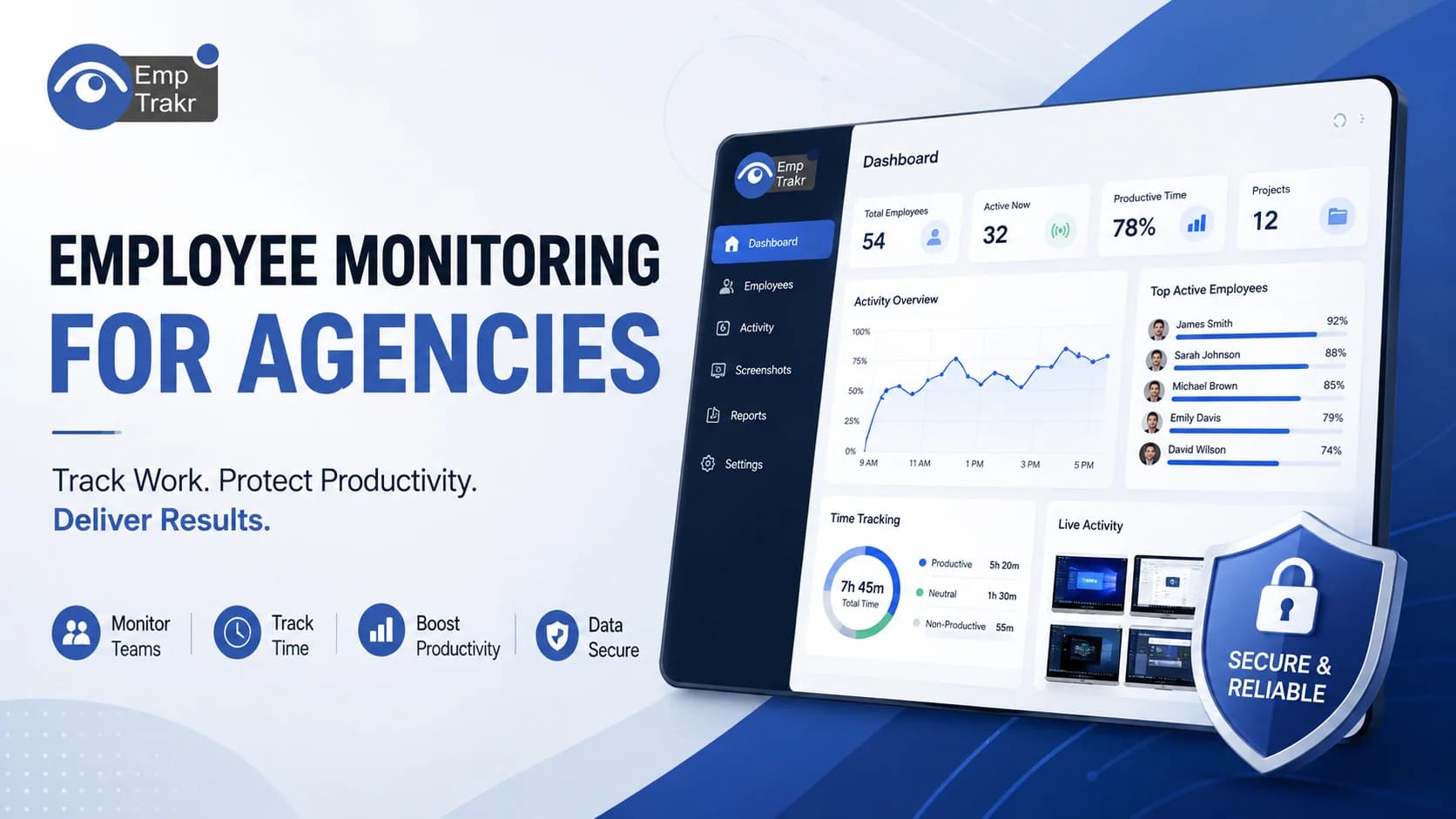
Employee monitoring for agencies is best approached as a route to clearer project and workforce visibility, not constant observation. Start with the official product destination, then check dashboard controls, time-tracking workflows, documentation, and privacy safeguards. Research on workplace surveillance also supports treating design and employee trust as part of the decision.
Employee monitoring for agencies: definition and decision context?
Employee monitoring for agencies refers to using workplace software to understand work activity, time, attendance, and project progress across distributed teams. The practical question is not whether a dashboard can collect more information, but whether the information helps managers coordinate client work without creating unnecessary observation.
A 2026 comparison describes modern teams working from locations such as kitchen tables, coworking spaces, and cafes, and evaluates monitoring tools through factors including reporting, integrations, privacy controls, and use-case fit. The 2026 software comparison That evidence describes a comparison framework, not a universal recommendation for every agency.
For a navigational search, begin with the Employee monitoring software Destination. Then confirm whether the workflow matches the agency’s needs: client-project productivity, remote agency time tracking, attendance, or team activity reporting.
Who should consider employee monitoring for agencies?
Agencies may consider these tools when managers need a consistent way to review work patterns across remote or hybrid teams. The decision is more defensible when the purpose is specific, such as coordinating project work, checking recorded time, or identifying workflow friction rather than observing every action.
Privacy should be part of that decision from the beginning. A 2025 research listing on workplace surveillance describes concerns about privacy erosion and ethical issues in designing computer-vision-based monitoring. The workplace surveillance research The extract does not establish a rule for every agency, so it should not be treated as a complete legal or technical standard.
Managers can therefore separate a genuine coordination need from a desire for greater visibility. If the need is mainly hours and project allocation, explore Time tracking software Before considering more intrusive activity collection.
Benefits and practical limitations
The main operational benefit is a shared view of work information. In an agency setting, that can help teams discuss project allocation, recorded effort, attendance patterns, or client-facing delivery using the same workflow. Those benefits depend on the data being relevant to the work and interpreted alongside context.
The limitations are equally important. A research extract refers to creative workplaces such as marketing agencies while discussing monitoring and management practices. Research on creative workplaces That reference does not prove that a particular dashboard improves agency performance, nor does it justify collecting every available signal.
Potential benefits
- Creates a common place to review time, attendance, or activity information.
- Can support conversations about project allocation when data is relevant.
- May help distributed teams make work patterns easier to discuss.
Practical limitations
- Activity data can be mistaken for performance without project context.
- More collection can increase privacy and trust concerns.
- Creative work may not be represented well by simple activity signals.
Use Productivity tracking As a separate evaluation category. Ask what decision each data type supports before enabling it.
Agency workforce tracking and the reader decision
Agency workforce tracking works best as a decision framework rather than a single activity score. Start by defining the management question, identify the minimum information needed, and decide who can access the result. This keeps the dashboard connected to operations instead of turning collection into an end in itself.
A workplace-surveillance overview surfaced in the approved research extract discusses the possibility that monitoring may affect creative behaviour. The workplace surveillance overview Because the supplied extract is only a search result, it supports caution rather than a precise conclusion about any one agency or software product.
For client-project productivity, compare project records with time and attendance information instead of treating one signal as definitive. For screenshot monitoring, review the narrower Screenshot monitoring Topic and document the business reason before adopting that workflow.
Remote agency time tracking and the reader decision
Remote agency time tracking should be designed around clear expectations, understandable reports, and a review process employees can follow. A tool can make information easier to gather, but it cannot decide whether a work pattern reflects productive client work, planning, learning, or an unavoidable interruption.
One research extract says technology design matters when surveillance is built into workplace systems and cites work connecting technology-enabled surveillance with employee learning and voice behaviour. The technology-design research The cited material is not a product test, so agencies should avoid translating it into a guaranteed outcome.
Keep the workflow practical: define the project or attendance purpose, explain the data being collected, limit access to people with a work need, and review whether the information is actually useful. Supporting pages on Attendance tracking And Security & privacy Can help organize those questions.
Conclusion
The official destination is only the starting point. Agencies should compare monitoring, time tracking, attendance, and activity reporting according to the specific operational problem they need to solve.
The approved research supports a cautious approach: distributed work creates a need for usable visibility, while workplace-surveillance research highlights privacy, ethics, creative work, and employee voice as relevant considerations. It does not support a universal product ranking or a claim that monitoring improves every agency.
Before implementation, write a short workplace monitoring policy, explain the purpose and scope, and test whether the selected reports help managers make fairer project decisions. For setup questions, consult the Installation guide And review the site’s Pricing Information directly.
Sources
- 6 Best Employee Monitoring Software [Top Picks for 2026] — tmetric.com
- Google Scholar workplace surveillance research results — scholar.google.com
Frequently Asked Questions
Where is the official employee monitoring for agencies site?
How can agencies configure employee monitoring dashboards?
What privacy rules affect employee monitoring for agencies?
Which time tracking tools support agency client projects?
Where can agencies find employee monitoring documentation and support?
Related EmpTrakr resources
Continue with product pages that match this topic — and explore more guides on the blog.
Supercharge your workforce today.
Join leading companies using EmpTrakr to boost productivity, streamline tracking, and optimize remote teams.