Unlock Productivity: The Best Free Clockify Alternative with Idle Detection| EmpTrakr
Compare Clockify vs automated trackers and discover a smarter free time tracker with idle detection. Find your ideal Clockify replacement for 2026.
Introduction
Corporate leaders continue to prioritize precise workforce analytics as organizations scale operations in competitive markets. Idle time detection remains a critical component of accurate time tracking, directly influencing productivity assessments and resource allocation decisions. Many executives seek a free Clockify alternative idle detection solution that integrates advanced automation without compromising data security or compliance standards.
Traditional tools often fall short in distinguishing between genuine work pauses and system inactivity, leading to inflated or inaccurate reports. A smarter free time tracker addresses these gaps through real-time monitoring and customizable thresholds. This approach supports better-informed strategic planning at the executive level.
The following sections examine current limitations in established platforms, compare Clockify vs automated trackers, and outline criteria for selecting an idle detection time tracking app suitable for 2026 corporate environments. Practical insights focus on implementation considerations that align with C-level priorities such as cost efficiency and operational oversight.
The Role of Idle Detection in Modern Time Tracking
Idle detection technology identifies periods of inactivity on employee devices and categorizes them according to predefined rules. This capability prevents overreporting of billable hours and provides clearer visibility into actual productive time across teams. For C-level executives, such data supports accurate forecasting and performance benchmarking without requiring constant manual oversight.
Organizations implementing an idle detection time tracking app report improved alignment between logged hours and project outcomes. Automated alerts notify managers when thresholds are exceeded, enabling timely interventions. These features reduce administrative burden while maintaining accountability standards expected in professional settings.
Integration with existing enterprise systems further enhances value by consolidating reports into centralized dashboards. Decision-makers gain access to trend analysis that informs staffing adjustments and budget reviews. Reliable idle detection therefore serves as a foundational element for data-driven leadership rather than a peripheral tracking function.
Clockify vs Automated Trackers: Key Differences for Enterprise Use
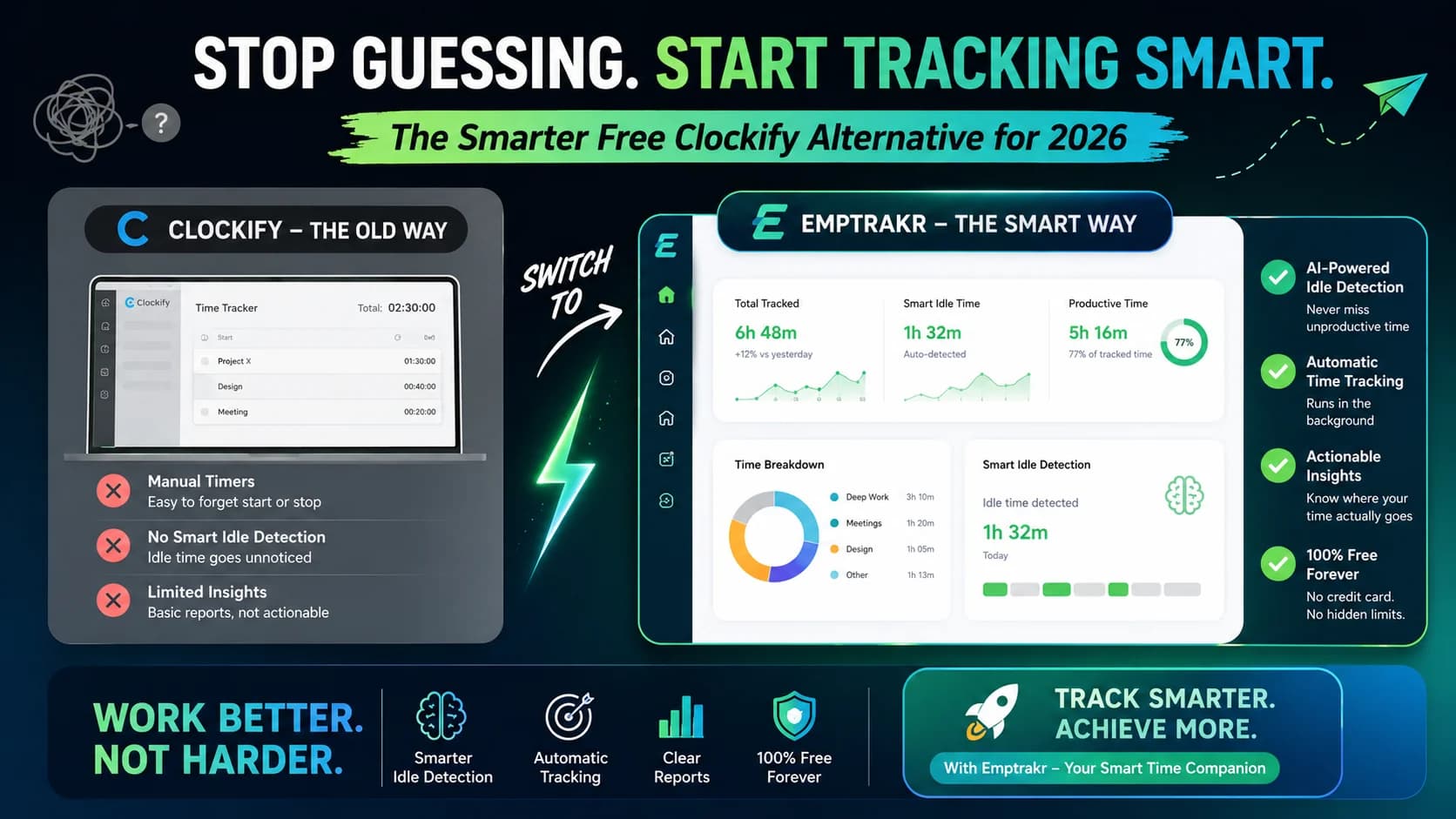
Clockify offers basic time logging but relies heavily on manual input for idle periods, which introduces inconsistencies in larger deployments. Automated trackers, by contrast, apply algorithms to monitor mouse and keyboard activity continuously. This distinction becomes significant when evaluating Clockify vs automated trackers for organizations managing distributed workforces.
Executives evaluating options note that smarter free time tracker solutions incorporate machine learning to refine detection accuracy over time. They distinguish between short breaks and extended inactivity more effectively than legacy manual systems. Such precision supports compliance requirements in regulated industries where audit trails must reflect actual work patterns.
Implementation of an idle detection time tracking app also allows policy customization, such as excluding specific applications from idle calculations. This flexibility accommodates diverse role requirements while preserving overall reporting integrity. Corporate teams benefit from reduced discrepancies during client billing cycles and internal reviews.
Selecting a Clockify Replacement 2026 With Advanced Capabilities
When considering a Clockify replacement 2026, decision-makers should prioritize platforms that combine zero-cost access with enterprise-grade idle detection features. Scalability ensures the solution grows alongside organizational needs without incurring unexpected licensing fees. Security protocols, including encryption and role-based permissions, protect sensitive productivity data.
Real-world applications demonstrate that companies adopting these alternatives achieve faster onboarding and higher user adoption rates. Training requirements remain minimal due to intuitive interfaces designed for professional environments. Integration options with project management and HR systems further streamline workflows across departments.
Further exploration of comparable free solutions appears in resources such as Top free Hubstaff alternatives for professional time tracking, which detail additional evaluation criteria. Executives are advised to conduct pilot programs to verify alignment with specific operational demands before full deployment.
Conclusion
Effective idle detection enhances accuracy in time tracking while supporting executive oversight of productivity metrics. Organizations benefit from transitioning to solutions that combine automation with cost efficiency in 2026. A free Clockify alternative idle detection platform delivers measurable improvements when selected based on enterprise requirements. Review available options to identify the most suitable idle detection time tracking app for your operations.
Related EmpTrakr resources
Continue with product pages that match this topic — and explore more guides on the blog.
Supercharge your workforce today.
Join leading companies using EmpTrakr to boost productivity, streamline tracking, and optimize remote teams.