Employee Monitoring Software Freeware Guide| EmpTrakr
Freeware monitoring tools often run on outdated code, bundled adware, or offer no real support. Learn the risks before installing one.
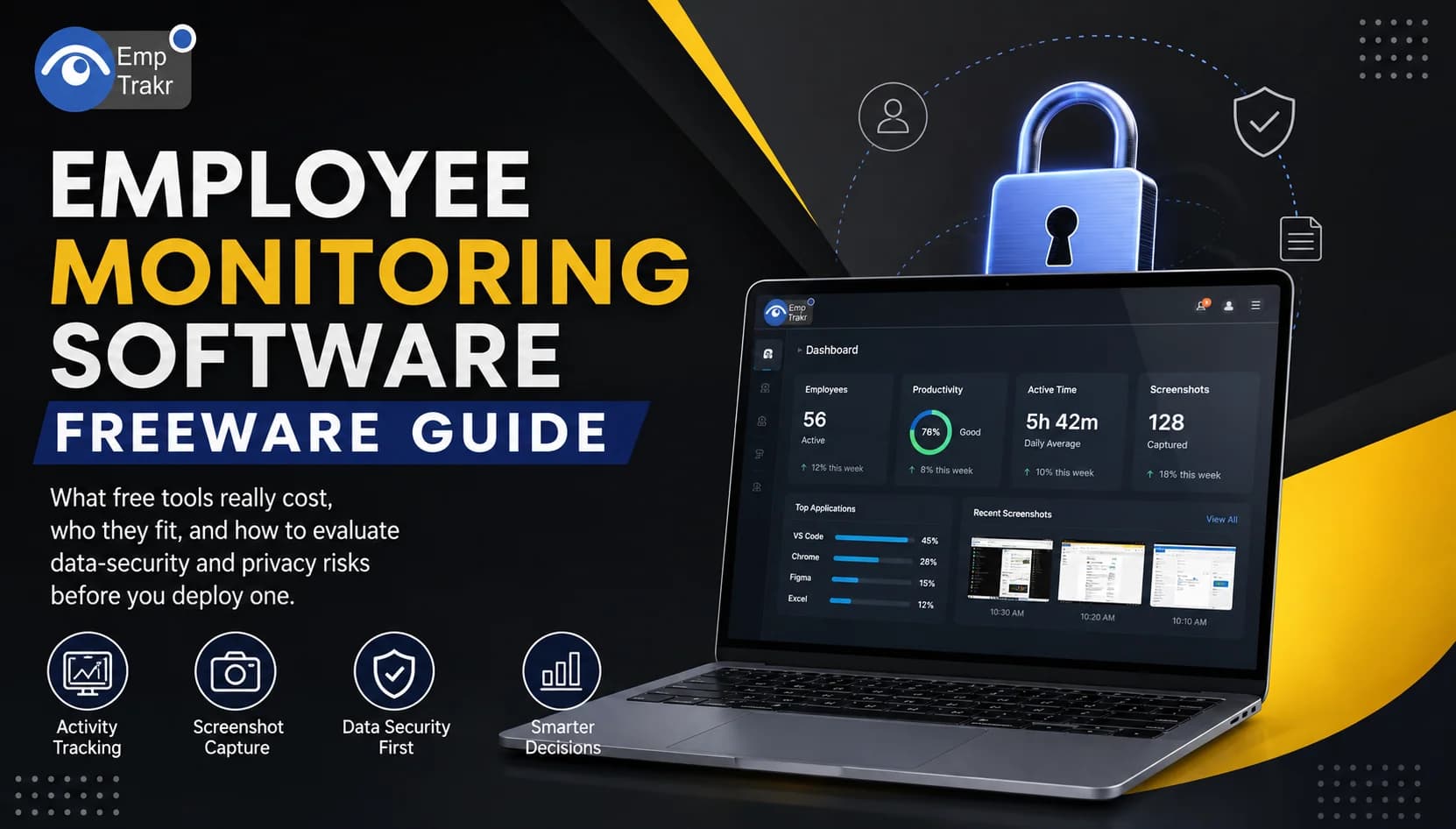
Employee monitoring software freeware refers to no-cost tools that track work activity, attendance, and productivity. It can suit budget-conscious teams, but "free" often carries hidden trade-offs around data security and privacy, so evaluate any tool carefully before rolling it out to staff.
- "Freeware" monitoring tools trade a zero price tag for potential data-security and privacy costs.
- Fit matters: small, budget-limited, or remote teams are the usual candidates for free tiers.
- One documented case ties a "free" tool to a client-data leak, underlining the security risk.
- Evaluate free tools with the same scrutiny you would give a paid one before deployment.
This article is for general informational purposes only and does not constitute legal advice. Workplace monitoring laws vary by country and state; consult a qualified attorney before implementing an employee monitoring program.
Employee monitoring software freeware: definition and decision context?
Employee monitoring software freeware is any no-cost application that tracks employee work activity — think time logs, attendance, app or browser usage, and sometimes screenshots — without an upfront license fee. For managers weighing it, the real question is not "is it free?" but "what does free actually cost?"
That distinction matters because the risks can be concrete. In one account, a consultant recalled A 2023 client incident In which a "free" monitoring tool installed to track a remote project was linked to a major client's campaign strategies and customer lists being leaked. It is a single anecdote, not a broad statistic, so treat it as an illustration of what can go wrong rather than a measure of how often it does.
The practical takeaway: free monitoring tools exist and can serve a purpose, but the decision context should center on data handling, transparency, and whether the tool's business model relies on your data. Start by mapping what you actually need — Employee monitoring software Capabilities vary widely — before assuming a free tier covers it.
Who should consider employee monitoring software freeware?
Freeware monitoring tools tend to make the most sense for very small teams, early-stage startups, or managers running a short-term pilot who want to understand the category before committing budget. If you have only a handful of remote or hybrid workers and a limited budget, a free tier can be a low-commitment way to see what the workflow feels like.
They are a poorer fit for teams handling sensitive client data, regulated information, or anyone who cannot vet the vendor's security and data practices. If your monitoring would touch confidential campaign work, customer records, or financial details, the downside of an unvetted free tool can outweigh the savings.
Consider your growth trajectory, too. A free tool that lacks reliable Time tracking software Features or clean exports may create rework once your team scales. The honest answer is that "who should consider it" depends less on company size alone and more on how much scrutiny you can apply to the tool before employees start using it.
Benefits and practical limitations
The clearest benefit of freeware is cost: it lets budget-constrained teams start tracking activity, attendance, or productivity without a purchase decision. Free tiers can also work as a proof of concept, helping managers learn which metrics actually matter to them before paying for a fuller platform.
The limitations are just as real. Free tools frequently cap the number of users, restrict features, or offer limited support, and — as the risk literature on this category warns — some monetize in ways that put your data or your employees' privacy at the center of the arrangement. That is the trade-off behind a zero price tag: the value has to come from somewhere.
Practical safeguards help. Read the privacy policy and data-retention terms, confirm where data is stored, limit what you collect to what you genuinely need, and be transparent with employees about what is tracked. If a free tool cannot answer basic questions about security or Productivity tracking Data handling, that opacity is itself a limitation worth weighing before you deploy it.
Attendance monitoring software and the reader decision
Attendance monitoring software is a common entry point into the broader monitoring category, because tracking who is working and when is often the first operational need for a remote or hybrid team. For many managers, attendance is a lower-sensitivity starting place than full activity capture.
When a free attendance tool is on the table, the decision hinges on accuracy and integration. Does it record clock-in and clock-out reliably? Can it export clean records for payroll or scheduling? Does it store personal data responsibly? These questions matter more than the headline that the tool is free.
Attendance data is also less intrusive than screenshots or keystroke logs, which can make it easier to introduce to a team with buy-in. Even so, the same evaluation discipline applies. Pair attendance tracking with clear communication about what is and isn't captured, and check whether the free tier's limits — on users, history, or reporting — will hold up as your team grows. A tool that handles Screenshot monitoring Separately from attendance can help you keep collection proportional to the actual need.
Employee attendance tracking software and the reader decision
Employee attendance tracking software overlaps heavily with attendance monitoring but often emphasizes the record-keeping side: timesheets, hours worked, and the data that feeds payroll or scheduling. The reader decision here is largely about data quality and downstream usefulness.
A free attendance tracker earns its place if its records are trustworthy and easy to move into the systems you already use. If you have to manually correct entries or rebuild reports, the time cost can quietly exceed whatever you saved on licensing. Reliable exports and clear audit trails are worth prioritizing.
Privacy and transparency remain part of the decision. Even attendance-focused tools collect personal work-pattern data, so employees deserve clarity on what is stored and for how long. Weigh the free tier's constraints against your real reporting needs, and confirm the vendor's data practices before you standardize on it. For teams still comparing categories, reviewing your Attendance tracking Requirements first makes the free-versus-paid choice far easier to reason about.
Conclusion
Employee monitoring software freeware can be a reasonable starting point for small, budget-conscious, or piloting teams — but "free" is a pricing model, not a guarantee of safety or fit. The core decision is whether you can vet the tool's data handling and privacy practices before employees rely on it.
Keep the limitations front of mind: feature caps, support gaps, and the documented possibility that a free tool's business model puts your data at risk. The single 2023 leak referenced here is an anecdote, not a trend, yet it captures why scrutiny matters more than price. Apply the same evaluation you would give a paid platform, be transparent with your team, and consult qualified legal counsel about monitoring rules in your jurisdiction.
If a free tier meets your needs after that review, it can be a sensible first step. If it can't answer basic questions about security or data use, treat that as your signal to look further before rolling anything out.
Sources
- The Risks of Employee Monitoring Software Freeware — eathealthy365.com, 2025-11-01T20:43:08.000Z
Frequently Asked Questions
What is employee monitoring software freeware?
Is employee monitoring software freeware suitable for the target audience?
How should readers evaluate employee monitoring software freeware safely?
Related EmpTrakr resources
Continue with product pages that match this topic — and explore more guides on the blog.
Supercharge your workforce today.
Join leading companies using EmpTrakr to boost productivity, streamline tracking, and optimize remote teams.